Genetic Risk Awareness and Knowledge of Cardiovascular Risk Factors Among Adults in Riyadh, Saudi Arabia: A Cross-Sectional Study
Introduction
Cardiovascular diseases (CVDs) are the leading cause of mortality worldwide and represent a major global public health challenge. According to recent global burden of disease estimates, over 19 million deaths annually are attributed to cardiovascular diseases, accounting for approximately 32% of all global deaths [1]. In addition to high mortality rates, CVDs contribute substantially to non-fatal disability, reduced quality of life, and growing healthcare expenditures globally.
In Saudi Arabia, cardiovascular diseases constitute a primary health burden and rank among the leading causes of death nationwide [2]. Rapid urbanization, economic development, and associated lifestyle transitions have fostered unhealthy dietary habits, physical inactivity, obesity, tobacco use, hypertension, diabetes mellitus, and hypercholesterolemia, all of which have driven a rising prevalence of CVDs within the Saudi population [3]. Importantly, these primary risk factors are largely modifiable through targeted preventive strategies and public health interventions.
Awareness and knowledge of cardiovascular risk factors are vital determinants of disease prevention and control. Landmark epidemiological research demonstrates that a vast majority of premature cardiovascular events can be prevented through primary and secondary interventions, including smoking cessation, body weight management, regular physical activity, dietary modification, blood pressure control, and adherence to prescribed pharmacotherapy [4]. Enhanced public awareness fosters early clinical screening, healthier lifestyle choices, and improved compliance with preventive recommendations.
Despite the proven efficacy of preventive measures, literature indicates that awareness and accurate perception of cardiovascular risk factors remain suboptimal across many populations [5–7]. Deficits in health literacy directly impede preventive behaviors and attenuate the impact of public health campaigns aimed at reducing cardiovascular morbidity and mortality. Furthermore, individuals presenting with multiple cardiovascular risk factors frequently exhibit optimistic bias, failing to accurately perceive their personal risk of developing clinical cardiovascular disease [6].
Although several studies in Saudi Arabia have evaluated public awareness of traditional cardiovascular risk factors, most have focused exclusively on modifiable behavioral or metabolic determinants within specific clinical subgroups or limited geographical regions [5–7]. Comparatively little research has examined public understanding of genetic cardiovascular risk and its relationship with the perception of modifiable lifestyle factors. Non-modifiable risk factors, particularly genetic predisposition and family history, play a major role in cardiovascular disease onset. Recognizing inherited risk can motivate individuals to pursue early screening, adopt preventive lifestyles, and engage in proactive health behaviors. This is particularly relevant in Saudi Arabia, where familial clustering of cardiovascular risk factors and hereditary conditions is accentuated by high rates of consanguinity.
Currently, limited empirical evidence exists regarding public awareness of genetic cardiovascular risk among adults in Riyadh, Saudi Arabia. Therefore, this study aims to assess awareness of genetic cardiovascular risk and evaluate knowledge of modifiable cardiovascular disease risk factors among adults residing in Riyadh. In addition, this study seeks to examine the association between genetic risk awareness and perceptions of modifiable risk factors, while identifying sociodemographic predictors of overall cardiovascular knowledge. The findings will provide actionable evidence to support targeted public health strategies and educational programs aimed at strengthening cardiovascular disease prevention across the Saudi population.
Methods
Study Design and Setting
This study employed a cross-sectional design and was conducted in Riyadh, Saudi Arabia. Data were collected from the general population residing in Riyadh through online distribution using social media platforms, email invitations, and other electronic channels to maximize outreach and participation.
Study Period
Data collection was carried out over a two-month period from November 1 to December 30, 2025.
Study Population
The study targeted general adults residing in Riyadh, Saudi Arabia, including both Saudi and non-Saudi residents.
Inclusion Criteria
Eligible participants were adults who met the following criteria:
- Aged 18–70 years
- Residing in Riyadh, Saudi Arabia
- Of either gender
- Able to read and complete the questionnaire independently
- Willing to provide informed consent
Exclusion Criteria
Participants were excluded if they met any of the following criteria:
- Outside the age range of 18–70 years
- Non-residents of Riyadh
- Inability to provide informed consent
- Submission of incomplete or duplicate questionnaires
Sample Size
The sample size was calculated using the Raosoft® Sample Size Calculator (Raosoft Inc.), based on a 95% confidence level, a 5% margin of error, and a 50% response distribution. The minimum required sample size was determined to be 385 participants. However, to improve the precision and reliability of the findings, a larger sample size of 485 participants was targeted.
Sampling Technique
A convenience sampling technique was used. Participants were recruited through online platforms, including social media networks and email distribution, allowing wide accessibility to adults residing in Riyadh.
Data Collection Tool and Procedure
Data were collected using a structured self-administered questionnaire developed in both Arabic and English. The questionnaire was adapted from previously validated studies assessing cardiovascular disease awareness and risk perception.
The questionnaire consisted of sections covering:
- Sociodemographic characteristics
- Awareness of genetic cardiovascular risk
- Knowledge of modifiable cardiovascular risk factors
The questionnaire was distributed electronically via Google Forms, and participants completed it voluntarily after providing informed consent.
Statistical Analysis
Data were analyzed using IBM SPSS Statistics for Windows, Version 25.0 (IBM Corp., Armonk, NY, USA). Descriptive statistics were utilized to summarize participant characteristics and survey responses. Categorical variables were presented as frequencies and percentages.
Knowledge of cardiovascular disease risk factors was assessed using 11 questionnaire items. Each correct response was assigned a score of 1, whereas incorrect and “I do not know” responses were assigned a score of 0. The total knowledge score ranged from 0 to 11 and was converted into a percentage score. Participants who achieved ≥70% of the total score were classified as having good knowledge, whereas those scoring <70% were classified as having poor knowledge.
To evaluate associations between knowledge levels (good vs. poor) and participants' sociodemographic and clinical characteristics (Table 4), cross-tabulations were performed using Pearson's chi-square test. Fisher's exact test was applied when expected cell counts were less than 5. A two-sided p-value < 0.05 was considered statistically significant for all tests.
Ethical Considerations
Ethical approval for this study was obtained from the Al-Imam Muhammad Ibn Saud Islamic University Institutional Review Board (IRB) under registration number HAPO-01-R-061 (Approval No. 858/2025). Informed consent was obtained electronically from all participants prior to questionnaire completion. Participation was voluntary, and confidentiality and anonymity of all respondents were strictly maintained throughout the study.
Results
Four hundred and eighty-five participants completed the survey (N = 485). All participants were adults aged 18 years or older. The study was conducted between November and December 2025.
The sociodemographic characteristics of the study participants are presented in Table 1. The majority of respondents were young adults (49.5% aged 18–24 years), female (56.3%), and single (59.8%). Regarding educational attainment and occupation, over half held a bachelor's degree (51.3%), and nearly half were students (48.0%). Family monthly income was well-distributed, with 29.5% earning <5,000 SAR and 29.5% earning 10,000–19,999 SAR. Most participants were never smokers (90.7%), while 5.8% were current smokers and 3.5% were former smokers. Over six in ten participants (60.6%) engaged in physical activity (≥30 minutes/week) 0–2 times per week. Overall, 38.4% (n = 186) reported a family history of heart disease, most commonly involving the father (23.5%) or mother (8.9%).
Table 1. Sociodemographic and family history characteristics of the study participants (n = 485).
| Variable | Category | Frequency (n) | Percentage (%) |
|---|
| Age group (years) | 18–24 | 240 | 49.5 |
| 25–34 | 60 | 12.4 |
| 35–44 | 57 | 11.8 |
| 45–54 | 76 | 15.7 |
| ≥55 | 52 | 10.7 |
| Gender | Female | 273 | 56.3 |
| Male | 212 | 43.7 |
| Marital status | Single | 290 | 59.8 |
| Married | 179 | 36.9 |
| Divorced | 9 | 1.9 |
| Widowed | 7 | 1.4 |
| Educational level | Bachelor's degree | 249 | 51.3 |
| High school | 128 | 26.4 |
| Diploma | 52 | 10.7 |
| Postgraduate studies | 37 | 7.6 |
| Intermediate school | 16 | 3.3 |
| Primary school | 3 | 0.6 |
| Occupation | Student | 233 | 48.0 |
| Employed | 121 | 24.9 |
| Unemployed | 90 | 18.6 |
| Retired | 41 | 8.5 |
| Family monthly income (SAR) | <5,000 | 143 | 29.5 |
| 5,000–9,999 | 84 | 17.3 |
| 10,000–19,999 | 143 | 29.5 |
| ≥20,000 | 115 | 23.7 |
| Smoking status | Never smoker | 440 | 90.7 |
| Current smoker | 28 | 5.8 |
| Former smoker | 17 | 3.5 |
| Physical activity (≥30 min/week) | 0–2 times | 294 | 60.6 |
| 3–5 times | 147 | 30.3 |
| >5 times | 44 | 9.1 |
| Family history of heart disease | None | 299 | 61.6 |
| Father | 114 | 23.5 |
| Mother | 43 | 8.9 |
| Brother | 22 | 4.5 |
| Sister | 7 | 1.4 |
| Diagnosis before age 60 years* | Yes | 129 | 26.6 |
| No | 63 | 13.0 |
| Not applicable | 293 | 60.4 |
*Among participants reporting a family history of heart disease. Abbreviations: SAR, Saudi Arabian Riyal.
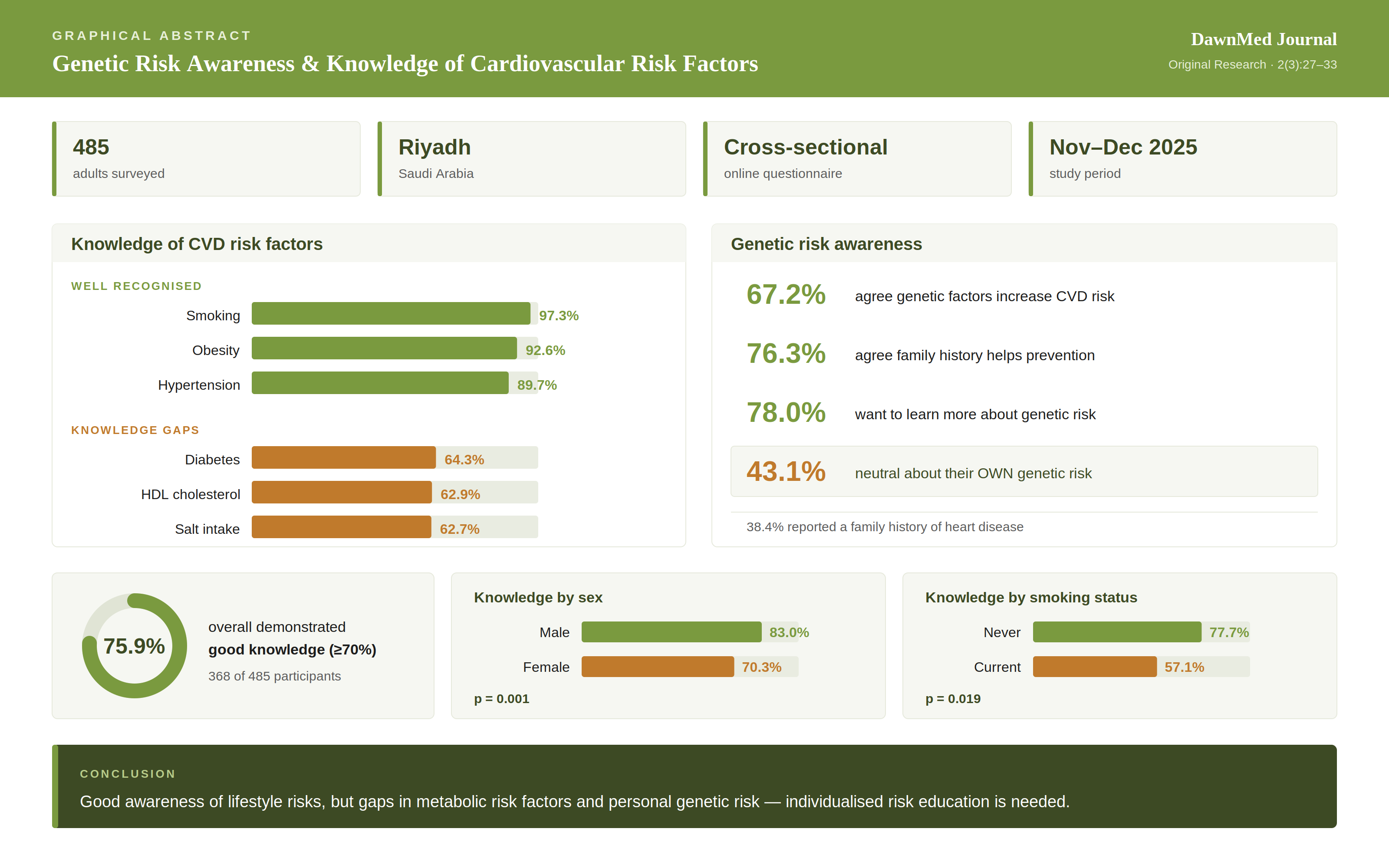
Participants demonstrated high overall awareness of traditional cardiovascular risk factors (Table 2). Over 90% of respondents correctly identified smoking (97.3%), obesity (92.6%), and high blood pressure (89.7%) as risk factors for heart disease. Furthermore, the vast majority recognized the protective effects of regular physical activity (96.1%) and blood pressure control (91.1%). In contrast, knowledge gaps were identified regarding lipid profiles and metabolic risk factors: only 62.9% understood the protective role of high-density lipoprotein (HDL) cholesterol, 62.7% identified excessive salt consumption as a risk factor, and 64.3% recognized diabetes as a risk factor.
Table 2. Participants’ knowledge of heart disease risk factors and prevention (n = 485).
| Statement | Correct (n, %) | Incorrect (n, %) | I don't know (n, %) |
|---|
| Smoking is a risk factor for heart disease | 472 (97.3) | 2 (0.4) | 11 (2.3) |
| Passive (secondhand) smoking increases the risk of heart disease | 404 (83.3) | 10 (2.1) | 71 (14.6) |
| High blood pressure is a risk factor for heart disease | 435 (89.7) | 1 (0.2) | 49 (10.1) |
| Controlling blood pressure reduces the risk of heart disease | 442 (91.1) | 1 (0.2) | 42 (8.7) |
| High LDL cholesterol increases the risk of heart disease | 429 (88.5) | 2 (0.4) | 54 (11.1) |
| High-density lipoprotein (HDL) cholesterol protects against heart disease | 305 (62.9) | 29 (6.0) | 151 (31.1) |
| Obesity increases the risk of heart disease | 449 (92.6) | 4 (0.8) | 32 (6.6) |
| Engaging in regular physical activity reduces the risk of heart disease | 466 (96.1) | 1 (0.2) | 18 (3.7) |
| Diabetes increases the risk of heart disease | 312 (64.3) | 21 (4.3) | 152 (31.3) |
| Controlling blood sugar reduces the risk of heart disease | 343 (70.7) | 13 (2.7) | 129 (26.6) |
| Excessive salt consumption increases the risk of heart disease | 304 (62.7) | 32 (6.6) | 149 (30.7) |
Percentages may not sum to 100 due to rounding. "I don’t know" indicates participants were unsure of the answer.
Findings regarding genetic risk awareness showed that participants generally acknowledged the role of heredity in cardiovascular health (Table 3). A majority agreed or strongly agreed (67.2% combined) that genetic factors increase heart disease risk, and 76.3% agreed or strongly agreed that knowing family history aids in disease prevention. Additionally, 76.7% acknowledged that risk could be reduced through healthy lifestyle choices even with a family history. However, personal risk perception was less pronounced, as 43.1% remained neutral regarding concern about their own genetic risk. Despite this, there was a high demand for information, with 78.0% expressing a desire to learn more about how genetics affect heart disease risk.
Table 3. Participants’ responses to statements on genetic risk awareness of heart disease (n = 485).
| Statement | Strongly disagree (n, %) | Disagree (n, %) | Neutral (n, %) | Agree (n, %) | Strongly agree (n, %) |
|---|
| I believe that genetic factors (such as family history) increase my risk of heart disease | 13 (2.7) | 18 (3.7) | 128 (26.4) | 206 (42.5) | 120 (24.7) |
| Even with a healthy lifestyle, family history may increase the risk of heart disease | 15 (3.1) | 53 (10.9) | 171 (35.3) | 190 (39.2) | 56 (11.5) |
| I understand how genetic factors contribute to the risk of heart disease | 14 (2.9) | 33 (6.8) | 160 (33.0) | 197 (40.6) | 81 (16.7) |
| Knowing my family history helps me prevent heart disease | 8 (1.6) | 17 (3.5) | 90 (18.6) | 240 (49.5) | 130 (26.8) |
| I feel confident in my knowledge about the genetic risks of heart disease | 8 (1.6) | 39 (8.0) | 163 (33.6) | 193 (39.8) | 82 (16.9) |
| I believe that genetic testing can provide useful information | 10 (2.1) | 14 (2.9) | 88 (18.1) | 226 (46.6) | 147 (30.3) |
| I can reduce my heart disease risk through healthy choices even with a family history | 6 (1.2) | 6 (1.2) | 101 (20.8) | 242 (49.9) | 130 (26.8) |
| I am concerned about my genetic risk for heart disease | 37 (7.6) | 75 (15.5) | 209 (43.1) | 119 (24.5) | 45 (9.3) |
| I would like to learn more about how genetics affect the risk of heart disease | 7 (1.4) | 7 (1.4) | 93 (19.2) | 223 (46.0) | 155 (32.0) |
Data are presented as frequency and percentage (n, %). Likert scale: 1 = Strongly disagree, 5 = Strongly agree.
Cross-tabulation analyses revealed the associations between participant characteristics and knowledge levels regarding CVD risk factors (Table 4). Overall, 75.9% (n = 368) of participants demonstrated good knowledge (≥70%). Knowledge level differed significantly by sex (p = 0.001), with males displaying a significantly higher proportion of good knowledge than females (83.0% vs. 70.3%). Smoking status was also significantly associated with knowledge (p = 0.019), where never smokers had a higher proportion of good knowledge (77.7%) compared to current smokers (57.1%) and former smokers (58.8%).
No statistically significant associations were observed across age groups (p = 0.746), educational levels (p = 0.618), occupations (p = 0.098), monthly income (p = 0.087), or physical activity levels (p = 0.060). Finally, knowledge levels were statistically similar between participants with and without a family history of heart disease (73.7% vs. 77.3%; p = 0.399).
Table 4. Association between participants’ characteristics and knowledge level of cardiovascular disease risk factors (n = 485).
| Variable | Category | Poor knowledge n (%) | Good knowledge n (%) | p-value |
|---|
| Gender | Male | 36 (17.0) | 176 (83.0) | 0.001 |
| Female | 81 (29.7) | 192 (70.3) | |
| Age group (years) | 18–24 | 61 (25.4) | 179 (74.6) | 0.746 |
| 25–34 | 13 (21.7) | 47 (78.3) | |
| 35–44 | 14 (24.6) | 43 (75.4) | |
| 45–54 | 20 (26.3) | 56 (73.7) | |
| ≥55 | 9 (17.3) | 43 (82.7) | |
| Educational level | ≤High school | 39 (26.5) | 108 (73.5) | 0.618 |
| Diploma | 14 (26.9) | 38 (73.1) | |
| Bachelor's degree | 56 (22.5) | 193 (77.5) | |
| Postgraduate | 8 (21.6) | 29 (78.4) | |
| Occupation | Student | 60 (25.8) | 173 (74.2) | 0.098 |
| Employed | 27 (22.3) | 94 (77.7) | |
| Unemployed | 26 (28.9) | 64 (71.1) | |
| Retired | 4 (9.8) | 37 (90.2) | |
| Monthly income (SAR) | <5,000 | 45 (31.5) | 98 (68.5) | 0.087 |
| 5,000–9,999 | 17 (20.2) | 67 (79.8) | |
| 10,000–19,999 | 33 (23.1) | 110 (76.9) | |
| ≥20,000 | 22 (19.1) | 93 (80.9) | |
| Smoking status | Never smoker | 98 (22.3) | 342 (77.7) | 0.019ª |
| Current smoker | 12 (42.9) | 16 (57.1) | |
| Former smoker | 7 (41.2) | 10 (58.8) | |
| Physical activity | 0–2 times | 81 (27.6) | 213 (72.4) | 0.060 |
| 3–5 times | 30 (20.4) | 117 (79.6) | |
| >5 times | 6 (13.6) | 38 (86.4) | |
| Family history | Yes | 49 (26.3) | 137 (73.7) | 0.399 |
| No | 68 (22.7) | 231 (77.3) | |
Values are number (percentage) within each category. P-values were calculated using the chi-square test, except for (ª) which was calculated using Fisher’s exact test due to expected cell counts below 5. Statistical significance was set at p < 0.05.
Discussion
This study assessed awareness of cardiovascular disease (CVD) risk factors and perceptions of genetic susceptibility among adults in Riyadh, Saudi Arabia. Cardiovascular diseases remain a major public health challenge, and improving awareness of both modifiable and non-modifiable risk factors is essential for strengthening prevention strategies. Beyond recognizing common cardiovascular risk factors, individuals require sufficient health literacy to understand personal risk, interpret health information, and make appropriate preventive decisions. Previous evidence indicates that limited health literacy is associated with poorer cardiovascular risk profiles and less favorable cardiovascular outcomes [8].
Overall, participants demonstrated high awareness of several traditional cardiovascular risk factors, particularly smoking (97.3%), obesity (92.6%), and hypertension (89.7%). These findings suggest that major lifestyle-related cardiovascular risks are relatively well recognized among the studied population. This pattern is consistent with previous research demonstrating that populations often show higher awareness of broad and visible cardiovascular risk factors, particularly smoking and obesity, compared with more complex clinical indicators [9]. However, awareness alone does not always translate into effective prevention behaviors, emphasizing the need for continued health education and individualized risk communication.
Despite high awareness of major risk factors, this study identified important gaps related to metabolic, lipid, and dietary risk factors. Awareness of excessive salt intake (62.7%), the protective role of HDL cholesterol (62.9%), and diabetes as an independent cardiovascular risk factor (64.3%) was comparatively lower. Similar findings have been reported among individuals at increased cardiovascular risk, where participants frequently recognize general cardiovascular risks but demonstrate limited understanding of cholesterol, metabolic control, and disease mechanisms [12]. These knowledge gaps may reduce individuals' ability to interpret laboratory findings, understand their personal risk profiles, and adopt targeted preventive behaviors.
A significant association was observed between demographic characteristics and cardiovascular knowledge levels. Male participants demonstrated a higher proportion of good knowledge compared with females (83.0% vs. 70.3%, p = 0.001), and never smokers demonstrated higher knowledge compared with current smokers (77.7% vs. 57.1%, p = 0.019). Differences in cardiovascular knowledge according to demographic characteristics have been reported in previous studies and may reflect variations in exposure to health information, healthcare utilization, and health literacy levels [8,13]. The lower knowledge among current smokers is particularly important because individuals who continue high-risk behaviors may benefit from targeted interventions that emphasize personal cardiovascular susceptibility and the benefits of risk reduction.
Interestingly, cardiovascular knowledge was not significantly associated with educational attainment, occupation, or monthly income. Although more than half of participants had a university degree (51.3%), knowledge gaps regarding lipid profiles, diabetes-related risk, and dietary factors persisted. This finding highlights that formal education does not necessarily translate into adequate health literacy. Health literacy involves the ability to obtain, understand, evaluate, and apply health information, and it represents an important determinant of cardiovascular prevention and health outcomes [8,13]. Therefore, effective cardiovascular education should focus not only on increasing information availability but also on improving comprehension and practical application of health information.
The study also revealed a discrepancy between recognizing family history of CVD and perceiving personal genetic susceptibility. Although 38.4% of participants reported a family history of CVD, many participants remained neutral regarding their own genetic risk. This finding may reflect unrealistic optimism, where individuals acknowledge that a disease risk exists but underestimate their own likelihood of experiencing that outcome [15]. Family history represents an important component of cardiovascular risk assessment, and genetic variation contributes substantially to coronary artery disease susceptibility and risk prediction [10,16]. Increasing awareness of inherited cardiovascular risk may encourage earlier screening and adoption of preventive behaviors among individuals with familial risk.
The high proportion of participants interested in receiving additional information about hereditary cardiovascular risk (78.0%) indicates a strong opportunity for improving genetic risk communication. Integrating family history assessment and appropriate genetic education into primary healthcare settings may support more personalized cardiovascular prevention strategies [14,16]. Healthcare professionals play an essential role in translating complex cardiovascular and genetic information into clear and actionable recommendations, particularly for individuals with varying levels of health literacy [8,13]. Community-based education initiatives and preventive healthcare approaches may further enhance cardiovascular risk awareness and promote healthier behaviors.
Limitations
This study has several limitations that should be considered when interpreting the findings. First, the cross-sectional design limits the ability to establish causal relationships between cardiovascular knowledge, awareness, and preventive behaviors. Second, the online convenience sampling strategy may have introduced selection bias, including overrepresentation of younger participants (49.5% aged 18–24 years) and individuals with higher educational attainment, which may limit the generalizability of findings to the broader Saudi population.
Additionally, reliance on self-reported data may have introduced recall bias and social desirability bias, potentially resulting in overestimation of cardiovascular knowledge or health-related behaviors. Finally, the study was conducted exclusively in Riyadh; therefore, findings may not reflect differences in cardiovascular awareness among rural populations or other regions of Saudi Arabia with varying socioeconomic conditions, healthcare accessibility, and cultural factors.
Conclusion
The findings of this study on awareness of cardiovascular disease risk factors and genetic susceptibility among adults in Riyadh, Saudi Arabia, demonstrate generally good awareness of traditional lifestyle-related risk factors such as smoking, obesity, and hypertension. However, important gaps remain in the understanding of metabolic risk factors, including cholesterol levels, dietary influences, and glycemic control, as well as in the interpretation of genetic and familial risk. Although a considerable proportion of participants reported a family history of cardiovascular disease, many were uncertain about their own genetic susceptibility, indicating a gap between awareness of family history and personal risk perception. In addition, despite relatively good overall knowledge, a substantial number of participants were unaware of their own blood pressure, cholesterol, or glucose status, reflecting a clear knowledge–action gap in preventive health behavior. Preventive practices such as regular screening and health monitoring were therefore not consistently applied. These findings highlight the need for targeted public health strategies that move beyond general awareness toward individualized risk education, improved health literacy, and stronger integration of genetic and clinical risk communication within primary healthcare services.
Conflicts of Interest
The authors declare no conflict of interest.
Funding
This work was supported and funded by the Deanship of Scientific Research at Imam Mohammad Ibn Saud Islamic University (IMSIU).
Author Contributions
Conceptualization, A.H.A.; methodology, A.H.A.; validation, A.H.A. and J.AL.A.; formal analysis, A.H.A.; investigation, J.AH.A. and J.AL.A.; resources, A.N.A., A.A.H.; data curation, A.H.A. and A.M.A.; writing—original draft preparation, A.H.A. and H.A.A.; writing—review and editing, A.H.A. and A.A.A.; visualization, A.N.A. and A.M.A.; supervision, S.U.K. All authors have read and agreed to the published version of the manuscript.
Informed Consent Statement
Informed consent was obtained from all subjects involved in the study.
Data Availability Statement
The raw data supporting the conclusions of this article will be made available by the authors on request.