Prevalence, Risk Factors, and Management of Migraine among the Adult Population in Saudi Arabia: A Review
Introduction
Migraine is one of the most frequent primary neurological diseases and is characterised by recurrent episodes of headache associated with nausea, vomiting, photophobia, and phonophobia [1]. Its mechanisms involve activation and sensitisation of the trigeminovascular system, cortical spreading depression, vasoactive peptides such as calcitonin gene-related peptide, and altered modulation of sensory and pain processing [2]. The consequences extend beyond headache pain to impaired work productivity, daily functioning, and quality of life [1, 3].
Headache disorders account for a substantial burden of disability in the Eastern Mediterranean Region [4]. In Saudi Arabia, epidemiological research has progressed from early community studies to more recent nationwide surveys [5, 6, 7]. These sources differ in their target populations and diagnostic approaches, making direct comparisons difficult. A population-based national estimate can inform service planning, whereas university, occupational, and clinical samples provide more specific information about the groups they represent.
Saudi studies have examined psychological stress and sleep quality in university students [8], environmental exposures such as altitude [9], and migraine among physicians working in primary care [10]. Other reports address sex, family history, psychiatric symptoms, screen exposure, and occupational factors. These variables may represent correlates of migraine, triggers of attacks, or factors associated with disability.
Management approaches include acute symptom treatment, preventive medication, lifestyle measures, and onabotulinumtoxinA for chronic migraine [1]. Local information about treatment use, disability, and medication overuse is useful alongside evidence of gaps in public awareness of migraine management [11].
Much of the available Saudi literature examines a particular city, institution, or subgroup, including university students and healthcare professionals. A synthesis that distinguishes these settings from national population evidence is therefore needed. This review examines prevalence, associated factors, and management outcomes in adults living in Saudi Arabia, while keeping findings from mixed-age samples separate from adult-specific conclusions.
Methods
Study Design and Protocol
This review was originally designed as a systematic review. During editorial and peer review it was reclassified as a review because the search was not fully reproducible (the exact search strings, a registered protocol, and a complete PRISMA-eligible exclusion log were not available) and the included studies were too heterogeneous for quantitative synthesis. Reporting therefore follows a narrative approach; SANRA was used as the reporting guide [12]. No meta-analysis was performed.
The review question concerned the prevalence of migraine, associated risk factors, and management strategies among adults living in Saudi Arabia. Population, condition, outcomes, study design, and setting were used to define eligibility.
Eligibility Criteria
The intended population was adults aged 18 years or older living in Saudi Arabia. Eligible outcomes concerned migraine prevalence, associated factors, management, treatment, or migraine-related health outcomes. Cross-sectional, cohort, case-control, randomised, controlled clinical, and quasi-experimental studies in community or healthcare settings were considered. Full-text, peer-reviewed articles in English, published from 2016 to the final search date, were eligible.
Studies outside Saudi Arabia, paediatric or adolescent studies without separate adult findings, case reports or case series, editorials, letters, commentaries, conference abstracts, dissertations, reviews, animal or laboratory studies, and knowledge-or-attitude-only studies without migraine outcomes were excluded by the stated criteria. Two retained reports enrolled participants from 16 years of age [13, 14], and neither reports results separately for adults. These two reports are therefore treated as contextual evidence and do not contribute to the adult-specific findings.
Information Sources and Search Strategy
PubMed, Scopus, and Web of Science were searched through 10 July 2026, and screening was completed on 11 July 2026. The strategy combined controlled vocabulary and keywords for migraine or headache disorders, adults, Saudi Arabia, and epidemiology, outcomes, or study design. Terms within concepts were combined as appropriate, and the four concepts were linked using AND; date and publication-type filters were applied where available. Database yields were PubMed, 236; Scopus, 216; and Web of Science, 200, giving 652 records before deduplication.
Findings were checked against the original articles, publisher pages, or indexed abstracts.
Study Selection Process
Deduplication by normalised title matching removed 130 records, leaving 522 for title and abstract screening. Of these, 471 were excluded and 51 reports were sought for retrieval. Nine were initially unavailable, one was subsequently retrieved, and eight remained unavailable. Thus, 43 reports were available for full-text assessment. Eighteen were excluded after assessment, leaving 25 retained reports. Exclusions concerned condition, population, outcome, or study design; only the total is reported. Of the 25 retained reports, 23 contribute to the adult-focused synthesis and two provide mixed-age context only. Figure 1 summarises this pathway.
Data Extraction
The extraction form recorded study identifiers, authors and publication year, city or setting, design, sample size, demographic features, migraine ascertainment, prevalence or proportions, associated factors, management and treatment outcomes, comorbidities, funding, and limitations. Numerical findings were recorded with their denominators and measurement definitions. Publication years refer to the journal issue year where assigned, rather than recruitment dates or an earlier online-first year. Companion reports were linked rather than treated as separate population samples.
Methodological Appraisal
Methodological limitations of the included studies were assessed descriptively.
The assessment considers non-probability sampling, restricted populations, migraine ascertainment, cross-sectional associations, absence of concurrent treatment comparators, and possible sample overlap. Non-cross-sectional reports are considered according to their design. Table 2 summarises the main considerations.
Data Synthesis
No pooled prevalence or effect estimate was calculated because case definitions, recall periods, populations, sampling methods, and outcome measures differed substantially. Results are organised as prevalence and burden, associated factors, and management or treatment outcomes. General-population estimates, screening positivity, self-reported migraine, prior clinical diagnosis, and proportions within symptomatic samples are distinguished. Findings based on the same sample are not summed, and cross-sectional associations are not interpreted as establishing causation.
Figure 1. Literature selection pathway.
| Stage | Number / disposition |
|---|
| Records identified | 652: PubMed 236; Scopus 216; Web of Science 200 |
| Duplicate records removed | 130 |
| Records screened by title / abstract | 522 |
| Records excluded at screening | 471 |
| Reports sought for retrieval | 51 |
| Reports not retrieved | 8 (nine initially unavailable; one subsequently obtained) |
| Reports assessed at full text | 43 |
| Reports excluded after full-text assessment | 18 in the original screening summary |
| Reports retained after the original screening | 25 |
| Adult-focused synthesis after the eligibility correction | 23 reports |
| Mixed-age context, not adult-specific evidence | 2 reports: Al-Hayani et al. [13] and Qarah et al. [14] |
Counts are reports, not independent studies. The two contextual reports are listed separately and do not contribute to the adult-specific findings.
Results
Study Selection
The searches identified 652 records. After removal of 130 duplicates, 522 titles and abstracts were screened, 51 reports were sought, and 43 were available for full-text assessment. Eighteen were excluded at that stage. The 25 retained reports comprise 23 adult-focused reports and two mixed-age contextual reports. No study contributed to a meta-analysis.
Characteristics of Included Reports
The retained reports were published in journal issues dated 2020–2026. The adult-focused set comprises 20 cross-sectional reports, one single-centre observational comparative report, and two retrospective treatment reports. The two mixed-age contextual reports are also cross-sectional. Sample sizes ranged from 30 in a botulinum toxin cohort to 2,316 in the national survey. Populations included community adults, university students, healthcare providers and nurses, people with migraine attending clinics, patients with mood disorders, and pregnant women. Table 1 summarises the characteristics of all 25 reports and identifies the two contextual records.
Studies were reported from Riyadh, Makkah/Jeddah, the Eastern Province including Al-Ahsa and Al-Khobar, Aseer, Qassim, Al-Baha, the northern region, and national or multi-region settings. The Madinah report is retained as mixed-age context. The national survey covered all 13 administrative regions; therefore, the absence of a region-specific report does not mean that region lacks coverage.
Table 1. Characteristics of the 25 retained reports.
| Report / issue year | Design and setting | Sample | Population / scope |
|---|
| Aljafen et al., 2025 [15] | Cross-sectional; Riyadh | 1,054 | Healthcare providers; 165 reported migraine self-medication |
| Labban et al., 2025 [16] | Cross-sectional; UQU, Makkah | 311 analysed* | 67 MS-Q-positive students; 95.5% female in this subgroup |
| Abumilha et al., 2025 [17] | Cross-sectional; Aseer | 395 | Adults ≥18 years; mean age 28.5 years |
| Aljaafari et al., 2021 [18] | Clinic-based cross-sectional; Al-Khobar | 121 | Patients with migraine; 79% female |
| Algahtani et al., 2021 [19] | Retrospective pre–post; Jeddah | 30 | Treated adults; reported age range 19–88 years |
| Al-Hayani et al., 2023 [13] † | Cross-sectional; national online survey | 247 | Ages 16–45 years; mixed-age context only |
| Al Harbi et al., 2021 [20] | Cross-sectional; Riyadh | 415 | Migraine survey; predominantly female |
| Aleyeidi et al., 2021 [21] | Cross-sectional; national online survey | 1,111 | Adults 18–65 years; headache and migraine outcomes |
| Alturaiki et al., 2023 [22] | Cross-sectional; Al-Ahsa | 353 | Healthcare providers with headaches; ages 20–60 years |
| Alharthi et al., 2023 [23] | Cross-sectional; multi-region | 411 | Pregnant women aged ≥18 years |
| Mohamed et al., 2026 [24] | Observational comparative; Khamis Mushait | 45 (30 vs 15) | Clinical comparison; mean age reported as 37.3 years |
| Alwhaibi et al., 2026 [25] | Cross-sectional; Riyadh neurology clinic | 152 | Adults with migraine |
| Alsabaani et al., 2026 [26] | Cross-sectional; national online survey | 229 | Participants with migraine; smoking comparisons |
| Qalawa et al., 2026 [27] | Multicentre cross-sectional; Qassim | 2,012 | Nurses aged 20–60 years; Saudi and non-Saudi residents |
| Esmaeel et al., 2024 [28] | Cross-sectional; northern region | 421 | Adults aged ≥18 years |
| Qarah et al., 2024 [14] † | Cross-sectional; Madinah primary care | 407 | Age criterion ≥16 years; mixed-age context only |
| Almadani et al., 2025 [29] | Clinic-based cross-sectional; Riyadh | 206 | Adults with mood disorders |
| Bamalan et al., 2021 [30] | Cross-sectional; Jeddah | 2,058 | Convenience sample of adults aged 18–60 years |
| Al Ghadeer et al., 2021 [31] | Cross-sectional; Al-Ahsa (Hofuf) | 82 | Clinic patients with migraine |
| Almosaiteer et al., 2022 [32] | Cross-sectional; Qassim online survey | 320 | Participants with migraine; 60.9% female |
| Attar et al., 2026 [33] | Retrospective cohort; Jeddah | 133 | Treated patients; 85% female; records from 2016–2024 |
| Al Maqwashi et al., 2024 [34] | Cross-sectional; national survey | 342 | Healthcare workers; 70.5% female |
| Agwa et al., 2023 [35] | Cross-sectional; Al-Baha University | 452 | Medical and non-medical students aged 18–29 years |
| Al Jumah et al., 2024 [36] ‡ | Population-based cross-sectional; all 13 regions | 2,316 | Ages 18–65 years; burden / healthcare needs |
| Al Jumah et al., 2020 [5] ‡ | Population-based cross-sectional; all 13 regions | 2,316 | Ages 18–65 years; headache-type prevalence |
* Labban et al. state 312 in the abstract and Methods but 311 analysed records in the Results. The 67/311 estimate is presented with this discrepancy noted. Its 95.5% female figure describes the 67 students with migraine, not the entire student sample. † Mixed-age reports are not adult-specific evidence. ‡ These are companion analyses of one national sample, not two independent surveys. UQU, Umm Al-Qura University; MS-Q, Migraine Screen Questionnaire.
Methodological Quality and Risk of Bias
The national population survey used random-digit-dial telephone sampling, an adapted HARDSHIP questionnaire, and age- and sex-adjustment, providing a stronger basis for a national estimate than restricted convenience samples [5, 36]. It nevertheless relied on questionnaire-based diagnosis, and the planned local diagnostic validation was not completed [5]. The two publications describe different outcomes from the same participants and cannot be counted as independent replication.
Several other reports relied on convenience or self-selected samples. Bamalan et al. explicitly used convenience sampling; their large sample should not be equated with representative probability sampling [30]. Online student and community surveys and samples limited to a clinic, occupation, or pregnancy population have corresponding restrictions on generalisability. The psychiatric survey, for example, recruited adults with mood disorders rather than a general adult population [29].
Cross-sectional studies cannot establish whether a reported exposure preceded migraine or whether disease severity influenced the exposure. Screening and self-report measures also differ from a prior clinical diagnosis. The retrospective treatment reports lacked concurrent untreated comparison groups, and both originated from the same Jeddah centre [19, 33]. Patient-level overlap could not be excluded from the available information. Table 2 summarises the principal methodological considerations.
Table 2. Descriptive methodological assessment of the evidence.
| Domain | Source-based observation | Implication for the synthesis |
|---|
| Population sampling | The national survey used random-digit dialling and weighting [5, 36]. Bamalan used convenience recruitment despite a large sample [30]. | National sampling has greater relevance to national prevalence; a large sample alone does not establish representativeness. |
| Restricted / self-selected samples | Student, occupational, online, psychiatric and other clinical samples address selected groups [16, 22, 27, 29, 32]. | Generalisability is restricted to the sampled settings and populations. |
| Migraine ascertainment | Measures include an adapted HARDSHIP diagnostic questionnaire, ID-Migraine, MS-Q, prior diagnosis, and simple self-report [5, 16, 27, 29, 30]. | Estimates reflect different case definitions; screening positivity is not equivalent to a clinical diagnosis. |
| Cross-sectional associations | Exposure, symptoms, comorbidities or severity were generally assessed at the same time [16, 17, 18, 26, 29, 34]. | Associations concern reported outcomes; temporal sequence and causality remain uncertain. |
| Treatment comparisons | Two retrospective botulinum toxin reports describe pre–post change without an untreated concurrent group [19, 33]. | Pre–post improvements may also reflect selection, concurrent care, or regression to the mean. |
| Sample overlap | National prevalence and burden reports use the same sample [5, 36]; the treatment reports originate from the same centre [19, 33]. | Linked reports do not provide independent replication. Participant totals are not summed across potentially overlapping samples. |
| Age eligibility | Two retained reports include participants younger than 18 years [13, 14]. | These reports provide mixed-age context and are not adult-specific evidence. |
| Source reporting | The student report gives inconsistent sample totals [16]. Headache and migraine terminology is not consistently separated in the shift-work report [34]. | Exact denominators and outcomes remain qualified where the source reporting is ambiguous. |
A report may have additional limitations not captured by these domains.
Synthesis of Findings by Review Objective
Prevalence of Migraine
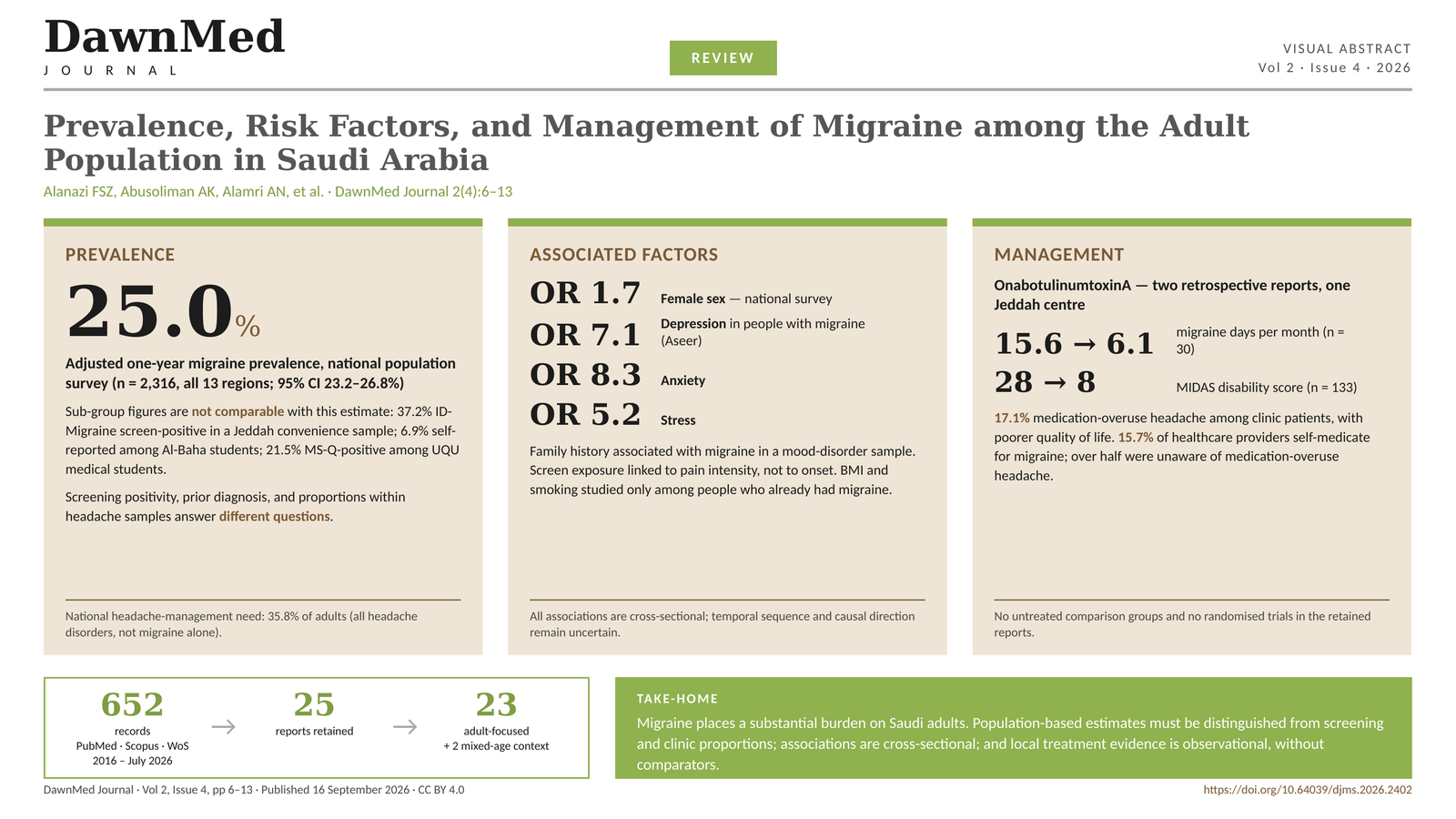
The national survey of 2,316 adults aged 18–65 years estimated an age- and sex-adjusted one-year migraine prevalence of 25.0% (95% confidence interval, 23.2–26.8%) [5]. Its companion burden analysis uses the same participants and should not be treated as a second independent prevalence estimate [36]. Across the other reports, differences in recruitment, case definition, and denominator prevent a meaningful single overall prevalence range.
In Jeddah, 37.2% of a convenience sample of 2,058 adults screened positive using ID-Migraine [30]. In Aseer, Abumilha et al. classified 159 of 395 respondents (40.3%) as having symptomatic migraine [17]. Among Al-Baha University students, the reported migraine proportion was 6.9% [35]. The UQU study reported 67 MS-Q-positive students among 311 analysed respondents (21.5%); the article separately gives 312 in its abstract and Methods [16]. These are not interchangeable estimates of national prevalence.
Denominators require particular care in occupational and clinical reports. The 4.5% figure in the Al-Ahsa healthcare-provider study refers to prior migraine diagnosis among 353 respondents who already had headaches, not migraine prevalence among all healthcare workers [22]. Among 206 adults with mood disorders, 22 had a prior migraine diagnosis (10.7%) and 43 screened positive on MS-Q (20.9%); these overlapping groups should not be added [29]. In the northern-region survey, migraine comprised 32.3% of the full sample, equivalent to 47.9% of respondents reporting any headache [28].
In the pregnancy survey, 145 of 411 respondents (35.3%) reported migraine; this was a questionnaire proportion, not a proportion of clinical headache visits [23]. Among Qassim nurses, 822 of 2,012 (40.9%) answered yes to having migraine and another 733 (36.4%) answered sometimes [27]. These categories should remain separate, and neither should be equated with a validated clinical prevalence estimate. The national burden report estimated that 35.8% of adults met its criteria for headache-management needs; that measure concerns headache disorders overall, not migraine alone [36].
Risk Factors and Associated Features
Female sex was associated with migraine in the national population survey and the mood-disorder sample [5, 29]. The national survey reported an odds ratio of 1.7 for women compared with men [5]. These are cross-sectional associations.
Psychiatric symptoms and migraine co-occurred in the Aseer community study and the mood-disorder sample [17, 29]. In Abumilha et al., the adjusted models compared the odds of psychiatric symptoms in respondents with and without migraine: odds ratios were 7.1 for depression, 8.3 for anxiety, and 5.2 for stress [17]. They do not estimate the risk of developing migraine after psychiatric illness. The mixed-age Al-Hayani and Qarah reports also address migraine and mental health, but their findings are retained as context rather than additional adult-specific replication [13, 14].
Family history was associated with migraine in the mood-disorder study [29]. The student screen-exposure report described family history among participants with migraine, but that descriptive frequency alone does not establish an association with migraine occurrence [16]. In the same student report, screen exposure was associated with pain intensity among the 67 students with migraine (p = 0.047); it was not shown to predict new migraine onset [16]. Occupational studies examined work schedules or perceived workplace factors; Al Maqwashi et al. reported an association with weekly working hours but not night-shift frequency, although its reporting did not consistently distinguish headache from migraine [27, 34], and the Riyadh environmental study described reported triggers [20].
The BMI study assessed migraine features among people who already had migraine [18]. Similarly, the smoking study compared migraine characteristics in smokers and non-smokers with migraine [26]. Their nonsignificant findings do not establish that BMI or smoking is unrelated to migraine occurrence in the general population. Headache-related associations in healthcare providers and findings during pregnancy likewise cannot automatically be attributed to migraine-specific mechanisms [22, 23].
Management and Treatment
Two retrospective reports described outcomes after preventive onabotulinumtoxinA treatment in Jeddah [19, 33]. In the 30-patient report, mean migraine days per month changed from 15.61 ± 10.92 to 6.14 ± 6.16 [19]. In the 133-patient report, median MIDAS disability score changed from 28 to 8 [33]. These within-cohort improvements are encouraging but cannot establish the magnitude of a causal treatment effect without an appropriate comparator. As both reports came from the same centre, independence of their patient samples should not be assumed.
Medication-overuse headache was reported in 26 of 152 clinic patients with migraine (17.1%) and was associated with poorer health-related quality of life [25]. Among healthcare-provider survey respondents, 165 of 1,054 (15.7%) reported migraine self-medication, commonly with paracetamol or nonsteroidal anti-inflammatory drugs; 55.8% of the self-medicating group were unaware of medication-overuse headache [15]. The Qassim quality-of-life study found poorer migraine-specific quality-of-life scores among respondents reporting paracetamol or other painkiller use [32]. This association may reflect greater symptom severity rather than an effect of analgesic use.
In the COVID-19 quarantine survey, 36 respondents used prophylactic treatment: 20 reported no change in use, 10 reported an increase, and six reported a decrease [21]. These responses do not establish treatment discontinuation or barriers to accessing medication. Other clinic-based reports addressed disability and clinical associations rather than controlled preventive-treatment effectiveness [24, 31]. None of the retained treatment reports was a randomised trial.
Discussion
This review retains 25 reports, with 23 contributing to the adult-focused synthesis and two separated as mixed-age context. The principal national estimate remains an adjusted one-year migraine prevalence of 25.0% in the 2,316-participant population survey [5]. The remaining evidence adds information about particular communities, occupations, students, and clinical groups, but should not be collapsed into an apparently uniform national prevalence range.
Saudi studies published before or alongside the retained reports provide useful context [6, 7, 37, 38, 39]. However, comparisons between different eras or regions cannot establish a rise in prevalence without comparable sampling and case definitions. Likewise, the proportion of patients presenting with migraine in an otolaryngology service is not directly comparable with community prevalence [40]. A lower proportion with a prior diagnosis than with a positive screening result, as observed in the mood-disorder sample, may indicate under-recognition, screening false positives, or both [29].
Female sex and psychiatric symptoms recur as correlates of migraine, but the designs do not establish causal sequence. Saudi university studies have also examined stress, sleep, depression, and migraine triggers [8, 41, 42]. Such findings are clinically relevant because headache and psychological distress may coexist and contribute to disability. Mixed-age data cannot be treated as independent adult-specific confirmation.
The distinction between migraine occurrence and migraine features is especially important. The BMI and smoking studies concern characteristics among respondents already experiencing migraine [18, 26]. The screen-exposure analysis concerns pain intensity within a migraine subgroup rather than the incidence of migraine [16]. Environmental and occupational reports describe perceived triggers or associations [9, 10, 20, 27, 34]. Research on tension-type headache addresses another headache phenotype [43]. The Eastern Region and Taibah University comparator surveys illustrate the variety of populations studied but do not resolve these differences in outcome definition [44, 45].
For management, the two onabotulinumtoxinA reports describe improvement in frequency or disability after treatment [19, 33]. Their retrospective design, lack of untreated comparison groups, and common institutional setting limit causal inference and the assumption of independent replication. They offer local clinical experience alongside the broader international treatment evidence.
Medication-overuse headache, self-medication practices, and quality-of-life findings highlight the importance of assessing how patients use acute medication [15, 25, 32]. Other Saudi reports also document headache-related disability, healthcare use, and knowledge gaps [11, 31, 46]. The association between analgesic use and poor quality of life may partly reflect confounding by indication: people with more burdensome migraine may use more medication. The quarantine study records changes in medication use, but cannot support a causal claim about pandemic-related medication-access barriers [21].
Variation in target populations, sampling, ascertainment, and recall periods is a plausible explanation for much of the variation between reports. These differences have direct implications for practice and policy. A clinic or occupational percentage should not be applied to the national adult population without qualification. Population-based surveys with transparent sampling and diagnostic procedures are more suitable for burden estimation, while clinical and occupational studies can guide questions relevant to their own settings [5, 36].
The national survey has important sampling strengths but lacks completed local diagnostic validation [5]. Large convenience samples remain vulnerable to selection bias [30]. Small clinical and uncontrolled treatment studies provide useful observations but cannot establish population prevalence or comparative effectiveness [18, 19, 24, 33].
Strengths and Limitations
The review brings together evidence across population, occupational, and clinical settings and preserves distinctions between prevalence, comorbidity, disability, and treatment outcomes. Linking the two national publications avoids treating the same participants as independent population samples. Checking the numerical summaries against their denominators also prevents confusion between screening positivity, prior diagnosis, and proportions among people with headache.
The absence of a registered protocol and of fully reported database strings limits reproducibility and means this work should not be cited as a PRISMA systematic review. English-only eligibility may have omitted relevant Arabic-language reports.
Two reports included adolescents as well as adults and are therefore separated from the adult-focused synthesis [13, 14]. Clinical heterogeneity prevented meaningful pooling, and narrative synthesis does not remove the selection and measurement limitations of the primary studies. Finally, limited region-specific evidence does not mean those regions lack coverage, because the population survey included all 13 administrative regions [5, 36].
Further research would benefit from standardised case definitions, transparent population sampling, prospective assessment of exposures, and controlled evaluations of preventive treatment in local practice.
Conclusion
The adult-focused synthesis draws on 23 reports, with two additional mixed-age reports retained for context. Migraine estimates vary by population and ascertainment, while the national population-based survey estimated an adjusted one-year prevalence of 25.0%. Female sex and psychiatric symptoms were recurrent associations, but causal direction remains uncertain. Saudi retrospective onabotulinumtoxinA reports describe clinical improvement without establishing comparative treatment effects. Medication-overuse headache and medication-use patterns are associated with migraine-related quality of life. The findings support the importance of migraine care but are limited by the heterogeneity and predominantly cross-sectional design of the primary studies.
Declarations
Conflicts of Interest: The authors declare no conflicts of interest.
Funding: This research received no specific grant from any funding agency in the public, commercial, or not-for-profit sectors.
Acknowledgments: The authors would like to thank their respective institutions for providing academic support and resources during the preparation and conduct of this review.
Author Contributions: F.S.Z.A. conceived and designed the review. A.K.A., A.N.A., M.Y.B.A., A.H.K., L.M.A.K., R.E.R., R.A.A., A.A.A., R.A.H.H., A.S.A.M., A.R.E.B., N.I.M.B., A.A.A.A., and A.M.M.A. conducted the literature search, study screening, data extraction, and quality appraisal. F.S.Z.A., A.K.A., and A.N.A. drafted the manuscript. All authors critically revised the manuscript for important intellectual content and agreed to be accountable for all aspects of the work.