Knowledge and Awareness of Tonsillitis Among Undergraduate Medical Students at the University of Bisha, Saudi Arabia: A Cross-Sectional Study
Introduction
The palatine tonsils are paired lymphoepithelial organs in the lateral walls of the oropharynx. Together with the adenoids and the lingual and tubal tonsils they form Waldeyer's ring [1], and as part of the mucosa-associated lymphoid tissue they are exposed to inhaled and ingested antigens and take part in local immune defense [2,3]. Tonsillitis, inflammation of the palatine tonsils, is usually caused by a viral or bacterial infection. It is a common condition, especially in children, and a common reason for clinic visits [4,5]. Acute sore throat, tonsillitis included, is often viral and usually settles within about a week without antibiotics [6,7]. Group A beta-hemolytic streptococcus (GAS; Streptococcus pyogenes) is the most common bacterial cause, accounting for 20–30% of sore throat presentations in children and 5–15% in adults [8]. It can cause suppurative complications and the non-suppurative sequelae of acute rheumatic fever and post-streptococcal glomerulonephritis, and it is the main indication for antibiotics in acute sore throat [8].
Consultations for pharyngotonsillitis vary with the season. In Swedish primary care they peaked in December and were least frequent in September [9]. In Saudi Arabia, 64% of 393 adults in an online survey in Taif reported having had acute tonsillitis, and bad breath was associated with a history of the condition [10]. Of 348 patients treated for tonsillitis in the Al-Baha region between 2019 and 2023, 65% had been diagnosed with acute follicular tonsillitis, 22% with acute tonsillitis and 9% with recurrent tonsillitis, and nearly three-quarters were children [11]. At a tertiary hospital in Hail, acute tonsillitis accounted for 4.11% of 2,646 patients admitted with infectious diseases [12].
Saudi research on knowledge of tonsillitis has mostly surveyed the general public and parents, with a focus on tonsillectomy and its effect on immunity [13–15]. A survey of 1,080 school and university students in Makkah covered ear, nose and throat (ENT) problems in general and found that only 16.3% had a good level of knowledge [16]. Among primary care physicians surveyed in Riyadh, almost 70% had average or poor knowledge of the indications for tonsillectomy [17]. To our knowledge, no study has looked specifically at what medical students in Saudi Arabia know about tonsillitis, although misconceptions about antibiotics are common in this group [18,19]. Asking students to rate their own knowledge is not enough, because self-assessment is an imperfect guide to competence [20,21].
We therefore measured both perceived and actual knowledge of tonsillitis among undergraduate medical students at the University of Bisha, compared the two, and examined sociodemographic and academic factors associated with awareness. The aim was to identify gaps that the curriculum could address.
Methods
Study design, setting and participants
This cross-sectional questionnaire study was carried out at the College of Medicine, University of Bisha, in southwestern Saudi Arabia, and data were collected online between 27 March and 11 April 2025. It is reported according to the Strengthening the Reporting of Observational Studies in Epidemiology (STROBE) statement [22] and, for the online survey, the Checklist for Reporting Results of Internet E-Surveys (CHERRIES) [23]. All undergraduate students registered in any of the six academic years of the medical program were eligible. Students from other programs, students who declined consent and those who had taken part in the pilot were excluded.
Sample size
The minimum sample size was calculated with Cochran's formula for a single proportion, n = Z²p(1 − p)/d², with Z = 1.96 for 95% confidence, an expected proportion (p) of 50%, the most conservative choice, and a margin of error (d) of 6%. This gave 267 participants. Recruitment continued past this number to allow for non-response and to improve precision. With the final sample of 320, the margin of error for a proportion of 50% is about ±5.5%.
Questionnaire and data collection
The online, self-administered questionnaire was adapted from the survey that Hariprasath et al. used with dental students [24]. It had three parts. The first recorded age, gender, marital status, academic year and monthly household income. The second contained eleven perceived-knowledge items answered "yes", "no" or "I don't know". Some asked whether students knew about a topic, such as the common bacterial causes of tonsillitis, and others asked whether they agreed with a statement, such as "tonsillitis is an infectious condition"; none required students to show the knowledge. The third part contained five multiple-choice items, each with one keyed correct answer, on the most common bacterial cause, the symptoms of streptococcal tonsillitis, the usual treatment for recurrent tonsillitis, complications and possible symptoms.
Awareness, the primary outcome, was derived from a knowledge score. Each "yes" answer to a perceived-knowledge item and each correct answer to a multiple-choice item scored one point, giving a total of 0 to 16, and students scoring 9 or more (more than half the maximum) were classified as aware.
The questionnaire link was shared in the WhatsApp and Telegram academic groups used by medical students at the University of Bisha, and students were also invited in person during scheduled teaching sessions. All responses were collected online; no paper forms were used.
Thirty students completed a pilot version to check that the items were clear and to assess internal consistency, which was good (Cronbach's alpha = 0.832). They were not included in the main sample.
Two problems with the instrument came to light after data collection. In the complications item, one option read "nodular glomerulonephritis", which is not a recognized complication of tonsillitis; the intended entity was post-streptococcal glomerulonephritis. Acute rheumatic fever, a major non-suppurative complication of GAS infection, was not offered as an option. Because the keyed answer ("all of the above") included the wrong term, this item cannot be treated as a valid measure of knowledge. Its results appear in Table 3 for completeness but are not interpreted, and the item has since been corrected. Separately, two perceived-knowledge items kept from the source instrument have no single accepted answer. One stated that acute tonsillitis lasts about 10 days, whereas most episodes resolve within about a week [6,7]. The other asked about a "genetic relationship between bacterial pharyngitis and tonsillitis", but the genetic evidence available concerns inherited susceptibility to recurrent tonsillitis [25]. Both items are reported descriptively only.
Ethical considerations
The Ethics Committee of the University of Bisha approved the study (E-CTS reference no. BIS-24-00021-22102024) before data collection began, and the study followed the Declaration of Helsinki. Participants were told the purpose of the study and gave electronic informed consent before taking part. Participation was voluntary, and responses were kept anonymous and confidential.
Statistical analysis
Data were analyzed with IBM SPSS Statistics version 25 (IBM Corp., Armonk, NY, USA). Categorical variables are presented as frequencies and percentages, and the knowledge score as mean and standard deviation (SD). The primary outcome was awareness (aware vs unaware). Perceived and actual knowledge measure different things, so they are reported separately. For the four topics covered by both a perceived-knowledge item and a valid multiple-choice item, we report the difference, in percentage points, between the proportion answering the multiple-choice item correctly and the proportion answering "yes" to the perceived-knowledge item. These comparisons are descriptive.
Before inferential analysis, sparse categories were merged: the 24–26 and 27–28 year age groups into 24–28 years, and the 11,000–20,000 and 20,000-or-more Saudi riyal (SAR) income brackets into >10,000 SAR. Associations between awareness and participant characteristics were tested with Pearson's chi-square test, or with Fisher's exact test (the Fisher–Freeman–Halton extension for tables larger than 2 × 2) when any expected cell count was below five. Age group and academic year are ordered variables, so the linear-by-linear association test for trend was also applied to them. Crude odds ratios (ORs) with 95% confidence intervals (CIs) were calculated from the contingency tables, and the crude OR per academic year from a logistic model with academic year as the only variable.
Independent predictors of awareness (aware = 1, unaware = 0) were examined by binary logistic regression, with age group, gender, academic year (entered as an ordinal variable, per year), marital status and income group as covariates. Results are given as adjusted ORs (aORs) with 95% CIs. All tests were two-sided, and p < 0.05 was taken as significant. One participant left four perceived-knowledge items blank, one response to the perceived complications item was invalid, and three participants left the complications multiple-choice item blank; all were scored zero.
Results
Participant characteristics
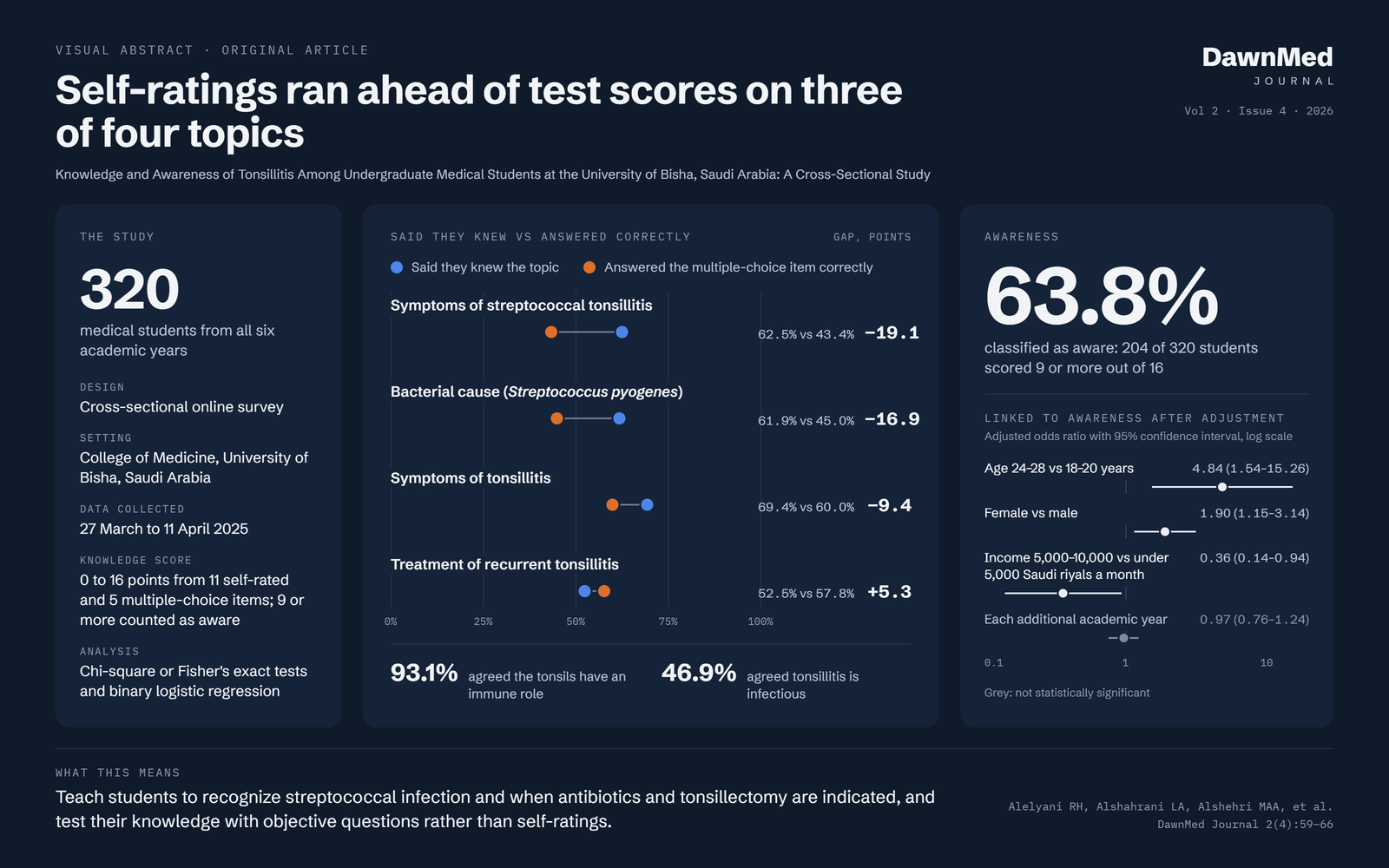
Of 366 responses received, 46 were excluded: 2 from respondents who did not consent and 44 removed by the investigators during data cleaning. Of these 44, 26 came from respondents aged 30 to 55 years and 18 came from pilot participants or contained inconsistent entries. The remaining 320 students were analyzed (Table 1). Nearly half were aged 21–23 years (48.8%), about a third were 18–20 years (34.4%) and 16.9% were 24–28 years. Male students formed a slight majority (55.9%), almost all participants were single (96.6%), and 89.7% reported a monthly household income below 5,000 SAR. Each academic year made up between 12.5% (first year) and 20.3% (fifth year) of the sample. The mean knowledge score was 9.36 (SD 4.00) out of 16; 204 students (63.8%) scored 9 or more and were classified as aware, and 116 (36.3%) as unaware.
Table 1. Sociodemographic characteristics of the participants (N = 320)
| Characteristic | Category | n | % |
|---|
| Age (years) | 18–20 | 110 | 34.4 |
| 21–23 | 156 | 48.8 |
| 24–28 | 54 | 16.9 |
| Gender | Male | 179 | 55.9 |
| Female | 141 | 44.1 |
| Marital status | Single | 309 | 96.6 |
| Married | 11 | 3.4 |
| Academic year | First | 40 | 12.5 |
| Second | 50 | 15.6 |
| Third | 61 | 19.1 |
| Fourth | 60 | 18.8 |
| Fifth | 65 | 20.3 |
| Sixth | 44 | 13.8 |
| Monthly household income (SAR) | <5,000 | 287 | 89.7 |
| 5,000–10,000 | 22 | 6.9 |
| >10,000 | 11 | 3.4 |
| Awareness of tonsillitis | Aware | 204 | 63.8 |
| Unaware | 116 | 36.3 |
SAR, Saudi riyal. The 24–28 year category combines the 24–26 year (n = 49) and 27–28 year (n = 5) groups, and the >10,000 SAR category combines the 11,000–20,000 SAR (n = 3) and 20,000 SAR or more (n = 8) brackets, to avoid sparse cells in the inferential analyses. Aware: knowledge score of 9 or more out of 16.
Perceived knowledge
Responses to the perceived-knowledge items are shown in Table 2. Almost all students (93.1%) agreed that the tonsils act as a defense mechanism, and most said they knew that halitosis can accompany tonsillitis (74.7%) and what its possible symptoms are (69.4%). Between 59.7% and 62.5% said they knew the symptoms of streptococcal tonsillitis, its common bacterial causes, its complications or home remedies, or agreed that acute tonsillitis lasts about 10 days. Only 52.5% said they knew the usual treatment for recurrent tonsillitis, and 38.8% answered "I don't know" to that item. Fewer than half agreed that tonsillitis is an infectious condition (46.9%; 43.4% answered "no"). The item on a genetic relationship between bacterial pharyngitis and tonsillitis had the lowest proportion of "yes" answers (43.4%) and the highest proportion of "I don't know" answers (45.0%).
Table 2. Perceived (self-rated) knowledge of tonsillitis (N = 320)
| Item | Yes, n (%) | No, n (%) | I don't know, n (%) |
|---|
| Tonsils act as a defense mechanism for the body | 298 (93.1) | 7 (2.2) | 15 (4.7) |
| Tonsillitis is an infectious condition | 150 (46.9) | 139 (43.4) | 31 (9.7) |
| Aware of the common bacterial causes of tonsillitis | 198 (61.9) | 30 (9.4) | 92 (28.8) |
| Aware of the possible symptoms of tonsillitis | 222 (69.4) | 15 (4.7) | 83 (25.9) |
| Acute tonsillitis lasts about 10 days† | 196 (61.3) | 47 (14.7) | 77 (24.1) |
| Know the typical treatment for recurrent tonsillitis | 168 (52.5) | 28 (8.8) | 124 (38.8) |
| Aware of the genetic relationship between bacterial pharyngitis and tonsillitis† | 139 (43.4) | 37 (11.6) | 144 (45.0) |
| Aware of home remedies for tonsillitis‡ | 191 (59.7) | 41 (12.8) | 87 (27.2) |
| Aware of the symptoms of streptococcal tonsillitis‡ | 200 (62.5) | 16 (5.0) | 103 (32.2) |
| Aware that halitosis accompanies tonsillitis‡ | 239 (74.7) | 14 (4.4) | 66 (20.6) |
| Aware of the complications of tonsillitis‡ | 198 (61.9) | 23 (7.2) | 97 (30.3) |
Items were answered "yes", "no" or "I don't know" and measure perceived, not verified, knowledge. The matching multiple-choice items are in Table 3. †No single accepted correct answer (see Methods); reported descriptively only. ‡One participant left this item blank; for the complications item, one further response was invalid.
Actual knowledge
Table 3 shows the multiple-choice results. Fewer than half of the students identified Streptococcus pyogenes as the most common bacterial cause of tonsillitis (45.0%) or recognized all the listed symptoms of streptococcal tonsillitis (43.4%). On the second of these items, 27.5% chose "white pus around the tonsils". Tonsillectomy was chosen as the usual treatment for recurrent tonsillitis by 57.8%, and 60.0% recognized all the listed symptoms of tonsillitis. On the complications item, 42.2% chose "all of the above", but because this option contained an incorrect term the result is not interpreted.
Table 3. Actual (multiple-choice) knowledge of tonsillitis (N = 320)
| Item | Keyed correct answer | Correct, n (%) | Incorrect or "I don't know", n (%) |
|---|
| Most common bacterial cause of tonsillitis | Streptococcus pyogenes | 144 (45.0) | 176 (55.0) |
| Symptoms of streptococcal tonsillitis | All of the above | 139 (43.4) | 181 (56.6) |
| Typical recommended treatment for recurrent tonsillitis | Tonsillectomy | 185 (57.8) | 135 (42.2) |
| Possible symptoms of tonsillitis | All of the above | 192 (60.0) | 128 (40.0) |
| Complications of tonsillitis‡ | All of the above | 135 (42.2) | 185 (57.8) |
The last column includes all answers other than the keyed answer, including three blank answers to the complications item. ‡Flawed item, not interpreted: one option read "nodular glomerulonephritis" instead of "post-streptococcal glomerulonephritis", and acute rheumatic fever was not offered, so students who chose "all of the above" picked a list that contained an incorrect term. The item has since been corrected.
Perceived versus actual knowledge
On three of the four topics covered in both formats, fewer students answered the multiple-choice item correctly than said they knew the topic (Table 4). The gap was widest for the symptoms of streptococcal tonsillitis (62.5% vs 43.4%; −19.1 percentage points), followed by the bacterial cause of tonsillitis (61.9% vs 45.0%; −16.9 points) and the symptoms of tonsillitis in general (69.4% vs 60.0%; −9.4 points). Treatment of recurrent tonsillitis went the other way: more students chose tonsillectomy (57.8%) than said they knew the usual treatment (52.5%; +5.3 points).
Table 4. Comparison of perceived and actual knowledge for topics assessed in both formats (N = 320)
| Topic | Perceived-knowledge item answered "yes", n (%) | Multiple-choice item answered correctly, n (%) | Difference (percentage points) |
|---|
| Symptoms of streptococcal tonsillitis | 200 (62.5) | 139 (43.4) | −19.1 |
| Bacterial cause of tonsillitis | 198 (61.9) | 144 (45.0) | −16.9 |
| Symptoms of tonsillitis | 222 (69.4) | 192 (60.0) | −9.4 |
| Treatment of recurrent tonsillitis | 168 (52.5) | 185 (57.8) | +5.3 |
Values are taken from Tables 2 and 3. Difference = percentage answering the multiple-choice item correctly minus percentage answering "yes" to the perceived-knowledge item, calculated from the rounded percentages shown. Complications are omitted because the multiple-choice item was flawed. The comparison is descriptive and made at group level.
Factors associated with awareness
Table 5 shows the bivariate analysis. Awareness rose with age group, from 53.6% at 18–20 years to 65.4% at 21–23 years and 79.6% at 24–28 years (p = 0.004; p for trend < 0.001). It was higher in female than in male students (69.5% vs 59.2%), but the difference was not statistically significant (crude OR 1.57, 95% CI 0.98–2.50; p = 0.057). Awareness also differed by academic year (p = 0.041) and tended to increase with seniority (p for trend = 0.012), from 60.0% in the first year to 77.3% in the sixth. The rise was not steady: awareness was lowest in the second year (46.0%), and fifth-year students (64.6%) were classified as aware less often than fourth-year students (70.0%). Marital status (p = 0.536) and household income (p = 0.258) were not associated with awareness.
Table 5. Bivariate associations between participant characteristics and awareness of tonsillitis (N = 320)
| Characteristic | Category | Aware, n (%) | Unaware, n (%) | Crude OR (95% CI) | p-value |
|---|
| Age (years) | 18–20 | 59 (53.6) | 51 (46.4) | 1 (Ref.) | 0.004* |
| 21–23 | 102 (65.4) | 54 (34.6) | 1.63 (0.99–2.69) | |
| 24–28 | 43 (79.6) | 11 (20.4) | 3.38 (1.58–7.23) | |
| Gender | Male | 106 (59.2) | 73 (40.8) | 1 (Ref.) | 0.057 |
| Female | 98 (69.5) | 43 (30.5) | 1.57 (0.98–2.50) | |
| Marital status | Single | 198 (64.1) | 111 (35.9) | 1 (Ref.) | 0.536 |
| Married | 6 (54.5) | 5 (45.5) | 0.67 (0.20–2.25) | |
| Academic year | First | 24 (60.0) | 16 (40.0) | 1 (Ref.) | 0.041* |
| Second | 23 (46.0) | 27 (54.0) | 0.57 (0.24–1.32) | |
| Third | 39 (63.9) | 22 (36.1) | 1.18 (0.52–2.68) | |
| Fourth | 42 (70.0) | 18 (30.0) | 1.56 (0.67–3.60) | |
| Fifth | 42 (64.6) | 23 (35.4) | 1.22 (0.54–2.74) | |
| Sixth | 34 (77.3) | 10 (22.7) | 2.27 (0.88–5.84) | |
| Monthly household income (SAR) | <5,000 | 187 (65.2) | 100 (34.8) | 1 (Ref.) | 0.258 |
| 5,000–10,000 | 11 (50.0) | 11 (50.0) | 0.53 (0.22–1.28) | |
| >10,000 | 6 (54.5) | 5 (45.5) | 0.64 (0.19–2.16) | |
Row percentages. OR, odds ratio; CI, confidence interval; Ref., reference category; SAR, Saudi riyal. p-values are from Pearson's chi-square test (age, gender, academic year) or Fisher's exact test (marital status; income, Fisher–Freeman–Halton extension), chosen according to expected cell counts. Linear-by-linear test for trend: age p < 0.001; academic year p = 0.012 (crude OR per additional year 1.20, 95% CI 1.04–1.39). Within the merged 24–28 year group, the 27–28 year subgroup (n = 5) had 40.0% awareness, too few for separate interpretation. *p < 0.05.
In the multivariable model (Table 6), age 24–28 years (aOR 4.84; 95% CI 1.54–15.26; p = 0.007) and female gender (aOR 1.90; 95% CI 1.15–3.14; p = 0.012) were independently associated with higher odds of awareness, and an income of 5,000–10,000 SAR with lower odds (aOR 0.36; 95% CI 0.14–0.94; p = 0.036). Academic year (aOR 0.97 per year; 95% CI 0.76–1.24; p = 0.827), age 21–23 years, marital status and an income above 10,000 SAR were not.
Table 6. Multivariable logistic regression of factors associated with awareness of tonsillitis (N = 320)
| Variable | Reference | aOR | 95% CI | p-value |
|---|
| Age 21–23 years | 18–20 years | 1.82 | 0.87–3.84 | 0.113 |
| Age 24–28 years | 18–20 years | 4.84 | 1.54–15.26 | 0.007* |
| Female gender | Male | 1.90 | 1.15–3.14 | 0.012* |
| Academic year (per year) | Ordinal | 0.97 | 0.76–1.24 | 0.827 |
| Married | Single | 0.52 | 0.13–2.12 | 0.363 |
| Income 5,000–10,000 SAR | <5,000 SAR | 0.36 | 0.14–0.94 | 0.036* |
| Income >10,000 SAR | <5,000 SAR | 0.56 | 0.15–2.14 | 0.395 |
Binary logistic regression with awareness as the outcome (aware = 1, unaware = 0); all variables were entered together. aOR, adjusted odds ratio; CI, confidence interval; SAR, Saudi riyal. Age and academic year are closely correlated, so their separate estimates should be interpreted with caution. *p < 0.05.
Discussion
Nearly two-thirds of the students (63.8%) were classified as aware of tonsillitis, and almost all agreed that the tonsils have an immune role. Their multiple-choice answers were weaker: fewer than half identified S. pyogenes as the main bacterial cause or recognized all the listed symptoms of streptococcal tonsillitis. In the yes/no items, fewer than half agreed that tonsillitis is infectious. Self-ratings ran ahead of test scores on three of the four topics we could compare. Awareness was higher in older students and in later academic years, and, after adjustment, in female students.
The high agreement on the immune role of the tonsils (93.1%) probably comes from preclinical teaching in immunology and anatomy. Doctors will need this knowledge when they discuss surgery with patients and parents, because many Saudi adults think that tonsillectomy affects immunity (36% in Abha and 54.6% in Qassim) [13,14].
The closest comparison is the survey by Hariprasath et al., who used a similar questionnaire with 100 dental students in India [24]. Several of their figures were of the same order as ours: 84% of their students knew the defensive role of the tonsils and 68% the possible symptoms of tonsillitis, and in multiple-choice questions 43% chose the commonest bacterial cause and 58% the standard treatment for recurrent tonsillitis. Infectivity was the clear exception. In their sample, 81% knew that tonsillitis is contagious; in ours, 46.9% agreed that it is infectious and 43.4% answered "no". Students who do not see tonsillitis as infectious may not advise patients about transmission and hygiene, or may not look for an infectious cause of a sore throat. In an earlier survey of 1,042 Saudi medical students, 18.1% thought antibiotics could be used for viral infections [18].
The gap between perceived and actual knowledge is the main finding of this study. On three of four comparable topics, the proportion who answered correctly was 9.4 to 19.1 percentage points lower than the proportion who said they knew the topic. This fits the tendency of people with limited knowledge to overestimate their competence [20] and the evidence that physicians and medical students assess themselves with at best moderate accuracy [21,26]. The exception, treatment of recurrent tonsillitis, may simply mean that tonsillectomy is a familiar option that can be picked without knowing when surgery is indicated. Because the comparison was made between groups, we cannot show that particular students overestimated themselves; that would need a paired analysis of each student's answers. Even so, students' self-ratings should not be taken as evidence of knowledge.
Knowledge of GAS was the weakest area. Only 45.0% of students identified S. pyogenes as the most common bacterial cause, and only 43.4% recognized all the listed symptoms of streptococcal tonsillitis, compared with 60.0% for the symptoms of tonsillitis in general. Between 20.6% and 32.2% answered "I don't know" to the perceived-knowledge items on symptoms. Recognizing GAS matters for treatment, because it is the bacterial cause that warrants antibiotics and the one linked to acute rheumatic fever and post-streptococcal glomerulonephritis [8]. Clinicians who cannot recognize streptococcal infection may end up giving antibiotics to most patients with a sore throat; in one outpatient series from Pakistan, all 210 patients with acute tonsillitis received an antibiotic and none had a throat culture [27]. Teaching could use cases in which students decide whether antibiotics are needed by applying the Centor, McIsaac or FeverPAIN score and, when indicated, a rapid antigen test, as current recommendations suggest [28].
Tonsillectomy was chosen for recurrent tonsillitis by 57.8% of students, and 38.8% answered "I don't know" to the perceived-knowledge item on its usual treatment. Our multiple-choice item treated tonsillectomy as the correct answer without qualification. Current recommendations are narrower. They mainly reserve tonsillectomy for patients who meet frequency thresholds (at least seven documented episodes in the preceding year, at least five a year in each of the preceding two years or at least three a year in each of the preceding three years) and advise watchful waiting below them [28,29]. The item therefore showed only that students recognized surgery as an option; it did not test whether they knew when to use it. Knowledge of the indications is incomplete even after graduation, as the Riyadh survey of primary care physicians showed [17], and many parents know little about the specific complications of recurrent tonsillitis or its surgical treatment [15,30].
Awareness rose with age group and, less consistently, with academic year, with a dip in the second year. Harakeh et al. found a similar progression among Saudi medical students for knowledge of antibiotic effectiveness, which rose from 28.6% in the first year to 92.9% in the sixth [18]. In our multivariable model, age 24–28 years remained associated with awareness but academic year did not (aOR 0.97). The two variables are closely correlated, and a sample of this size cannot separate their effects reliably; academic year was also entered as a linear term although its pattern was not linear. The safest reading is that more advanced students were more often classified as aware; the data cannot tell whether this reflects teaching, age or clinical exposure. The second-year dip may relate to when the topic is taught and is worth examining.
Female students were classified as aware more often than male students (69.5% vs 59.2%). The difference was not significant on its own (p = 0.057) but was after adjustment (aOR 1.90). Women also scored higher in other Saudi studies, both among medical students asked about antibiotics [18,19] and among primary care physicians asked about tonsillectomy indications [17]. Overconfidence may not explain the difference, since female medical students tend to underestimate their performance [21]. Study habits and engagement with self-directed learning are other possible explanations, but we did not measure them. Marital status showed no association. Students with a monthly income of 5,000–10,000 SAR had lower adjusted odds of awareness, but this group included only 22 students and income was not associated with awareness on its own, so the finding may be due to chance. Almost all students were single (96.6%) and in the lowest income group (89.7%), which limited the power to examine these variables.
Strengths and limitations
To our knowledge, this is the first study of tonsillitis knowledge among medical students in Saudi Arabia. It covered all six academic years and exceeded the calculated sample size, and because it measured perceived and actual knowledge separately, it could show the gap between them.
Because the design was cross-sectional, it cannot show that medical education caused the higher awareness of senior students; a longitudinal study would be needed for that. All data were self-reported online, and social desirability may have inflated answers to the perceived-knowledge items in particular. Convenience sampling through social media groups and classroom invitations may have favored students with an interest in the topic, and because we do not know how many students saw the invitation, no response rate can be given. The study was done at one college, so the results may not apply to other universities, regions or health disciplines.
The instrument had weaknesses of its own. It was adapted from a survey whose full questionnaire and validation have not been published [24]. The awareness score gave the same point for a "yes" to a perceived-knowledge item as for a correct multiple-choice answer, it included the flawed complications item and the two items without an accepted answer, and its cut-off of 9 (more than half the maximum) is a convention rather than a validated threshold. The treatment item did not test knowledge of indications, and actual knowledge rested on five multiple-choice items, one of which could not be interpreted. Perceived and actual knowledge were compared only at group level. Finally, age and academic year are closely correlated, so their separate estimates in the model need caution, and the smallest subgroups (married students and the two higher income groups, 11–22 students each) produced imprecise estimates.
Conclusion
Nearly two-thirds of medical students at the University of Bisha were classified as aware of tonsillitis, but fewer than half could identify S. pyogenes as its main bacterial cause or recognize all the listed symptoms of streptococcal tonsillitis. Their self-ratings were higher than their test scores on both of these topics and on the symptoms of tonsillitis in general, and fewer than half agreed that tonsillitis is infectious. Awareness was higher among older and more senior students and, after adjustment, among female students. Teaching should focus on recognizing streptococcal infection and on the indications for antibiotics and tonsillectomy, and students' knowledge should be tested with objective questions. A multicenter study with a validated questionnaire would show whether these results hold at other colleges.
Declarations
Funding: No external funding was received for this study.
Conflict of Interest: The authors declare no conflicts of interest related to this study.
Consent to Participate: All participants provided informed electronic consent before completing the questionnaire. Participation was voluntary, and participants could withdraw at any time without providing a reason.
Data Availability: The data that support the findings of this study are available from the corresponding author upon reasonable request, subject to institutional and ethical restrictions.
Acknowledgment
The authors extend their sincere appreciation to Bisha University and the College of Medicine for their continuous support throughout the course of this study. We also thank the undergraduate medical students who participated in the survey for their valuable time and honest responses. Special thanks are extended to everyone who offered guidance, encouragement, or assistance during the research process.
Disclosure
The authors declare no conflicts of interest concerning this study. No financial support or external funding was received. This research was conducted independently as part of academic requirements.