Abdulrahman M Alquraynis¹, Abdullah K Abusoliman²*, Alanoud H Alruqi³, Yazeed A Asery⁴, Reem A Alshehri⁵, Eyad S Alhashim⁶, Abdulaziz A Alnuwaysir⁷, Ahmed A Alzahrani⁶, Luay M Almutair⁸, Ibrahim E Almaski⁶, Suliman A Alluhib², Razan M Albalawi⁹, Ibtisam A Mohammed¹⁰, Ali M Alqahtani¹¹, Ahmed A Hejazi¹².Rotator Cuff–Related Shoulder Pain in the Overhead Athlete: A Phase-Based Rehabilitation and Return-to-Sport Framework. DawnMed Journal of Medical ScienceVolume 2, Issue 4:p: 48-58,2026.
Rotator Cuff–Related Shoulder Pain in the Overhead Athlete: A Phase-Based Rehabilitation and Return-to-Sport Framework
Abdulrahman M Alquraynis¹, Abdullah K Abusoliman²*, Alanoud H Alruqi³, Yazeed A Asery⁴, Reem A Alshehri⁵, Eyad S Alhashim⁶, Abdulaziz A Alnuwaysir⁷, Ahmed A Alzahrani⁶, Luay M Almutair⁸, Ibrahim E Almaski⁶, Suliman A Alluhib², Razan M Albalawi⁹, Ibtisam A Mohammed¹⁰, Ali M Alqahtani¹¹, Ahmed A Hejazi¹²
Received: July 20, 2026 | Peer reviewed: September 18, 2026 | Accepted: September 29, 2026 | Published: October 20, 2026
Cite this article as
Alquraynis AM, Abusoliman AK, Alruqi AH, Asery YA, Alshehri RA, Alhashim ES, et al. Rotator Cuff–Related Shoulder Pain in the Overhead Athlete: A Phase-Based Rehabilitation and Return-to-Sport Framework. DawnMed Journal 2(4):48–58 https://doi.org/10.64039/djms.2026.____
Volume 2, Issue 4,2026
Pages: 48-58
Abstract
Background: Rotator cuff–related shoulder pain is among the most common problems in athletes whose sport demands repeated overhead loading. Rehabilitation is first-line care, yet clinicians have little guidance on how to sequence it or on when an athlete is ready to compete again.
Aim: To provide clinicians with a practical framework for assessing rotator cuff–related shoulder pain in the overhead athlete, staging rehabilitation and structuring the return-to-sport decision.
Methods: This clinical practice review draws on seven clinical studies of rehabilitation in overhead athletes and four guideline, consensus and narrative sources. Outcome values were extracted from the published tables of each study and compared with published minimal clinically important differences where these were available. The review is not systematic and does not aim for exhaustive coverage.
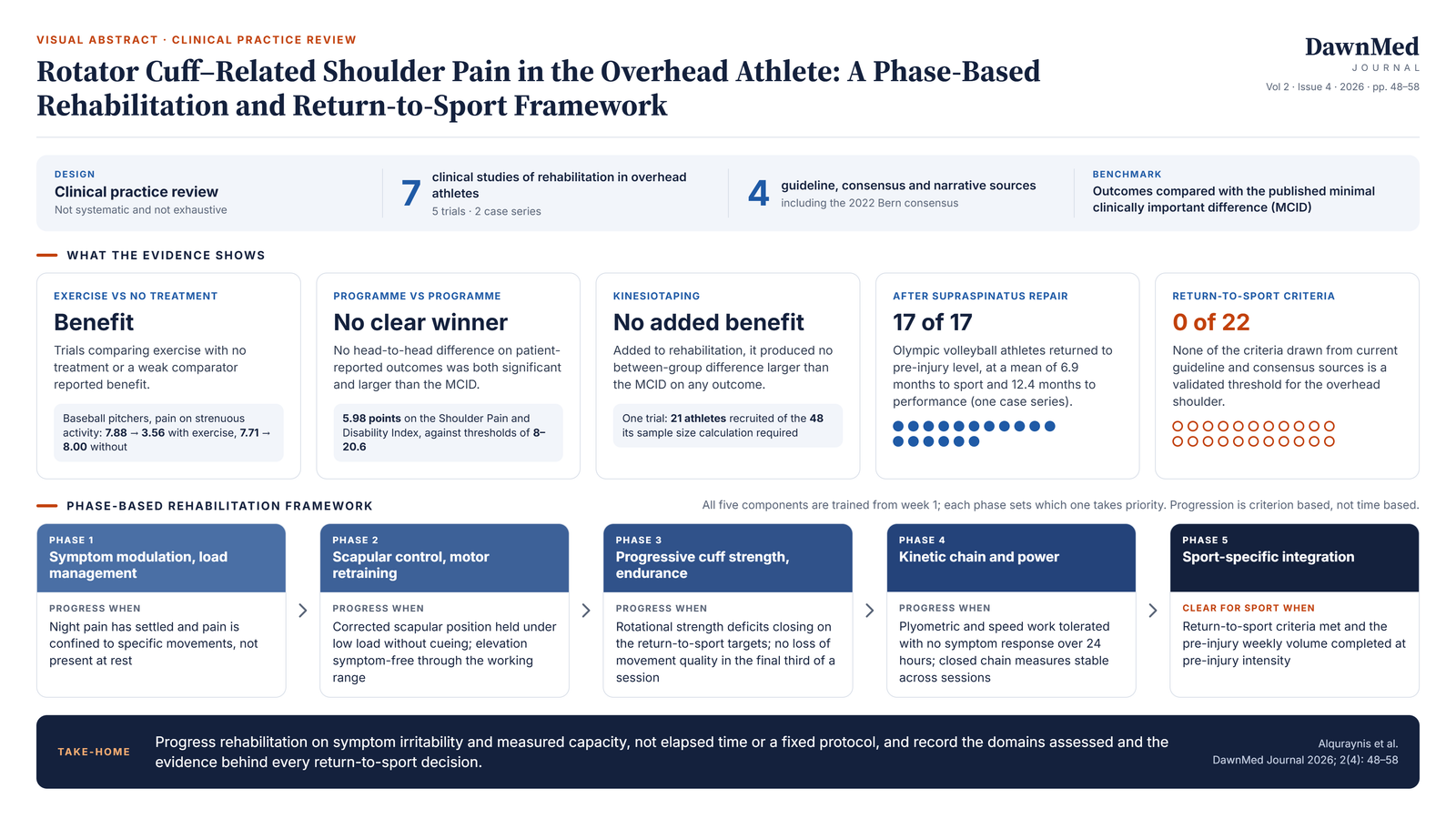
Results: Trials comparing exercise with no treatment or a weak comparator reported benefit. On patient-reported outcomes, no comparison between two active programmes produced a difference that was both statistically significant and larger than the published minimal clinically important difference: physio-yogic versus scapular recruitment exercise, p=0.180; scapular dyskinesis–based versus multimodal therapy, 5.98 points on the Shoulder Pain and Disability Index against published thresholds of 8 to 20.6 points; kinesiotaping added to rehabilitation versus rehabilitation alone, all differences below threshold. After arthroscopic supraspinatus repair in 17 Olympic volleyball athletes, all returned to their pre-injury level, at a mean of 6.9 months to sport and 12.4 months to performance. None of the 22 return-to-sport criteria drawn from current guideline and consensus sources is a validated threshold for the overhead shoulder.
Conclusion: Supervised, progressively loaded exercise appears to be the effective component of rehabilitation in these athletes, and no specific exercise programme has outperformed another credible programme on patient-reported outcomes. Clinicians are better served by a framework for sequencing and progressing rehabilitation, with explicit return-to-sport criteria, than by a fixed protocol.
1. The clinical problem in the overhead athlete
Reported shoulder injury rates in overhead throwing and smashing sports range from 18% to 61%, and reach 90% in elite swimmers [1]. Rotator cuff disorders account for more than half of all shoulder conditions seen by clinicians [2]. A single traumatic event is rarely the cause in athletes. More often, cumulative load has outpaced the capacity of the tissue.
Maximum humeral internal rotation velocity during throwing reaches 7000° to 7500° per second, and the throwing arm passes through 165° to 175° of external rotation during late cocking [1]. Competitive swimmers cover 10 to 14 km a day, six or seven days a week, amounting to roughly 16 000 shoulder revolutions per week, most performed in sequence with no recovery interval for the muscles involved [1].
Two features of this population complicate routine shoulder care. Structural findings are unreliable guides: many athletes, particularly at elite level, train and compete with asymptomatic abnormalities on magnetic resonance imaging, and treating the scan can misdirect rehabilitation [3]. Freedom from pain in daily life is also not enough. A pitcher can be comfortable at rest and still lack the external rotator endurance to finish the last third of a training block without losing mechanics.
Treatment aimed only at settling symptoms tends to produce an athlete who is comfortable at rest but breaks down when full training volume resumes. Treating the problem as a mismatch between tissue capacity and a known weekly load changes what is measured and what counts as success.
This review covers assessment, the order of loading, progression and the return-to-sport decision, and notes where the evidence is too thin to guide practice.
2. Pathomechanics of the overhead shoulder
Throwing and smashing are whole-body movements. Energy is generated proximally and transferred distally through linked segments, and a deficit anywhere along the chain is usually compensated for by the segments further along it [1]. Because the shoulder lies near the end of the chain, a deficit at the hip, trunk or scapula increases the load it must absorb, and in overhead sport that load is repeated thousands of times each week.
Within the shoulder, scapular position and control determine the platform on which the rotator cuff works. Insufficient upward rotation, posterior tilt and external rotation of the scapula during elevation alter the position of the glenoid relative to the humeral head and change the demand placed on the cuff. During deceleration the cuff has to resist glenohumeral distraction at very high angular velocities. It does this less well as a session goes on and fatigue builds.
Training load and fatigue are the principal modifiable factors. In a cohort of 679 handball players followed over 31 weeks, those with reduced external rotation strength or scapular dyskinesis tolerated smaller weekly increases in training and match hours than stronger players or those without dyskinesis [3]. Most other candidate risk factors in overhead sport have limited supporting evidence, and several of the better-supported ones, such as age and sex, cannot be modified [1].
Range of motion is easy to misread in these athletes. Loss of internal rotation and gain of external rotation on the dominant side are physiological adaptations to years of throwing and do not in themselves require correction [3]. Published cut-offs separating adaptation from pathology range from 18° to 25°, and the conservative values given in Section 9 reflect this uncertainty [1].
The 2022 Bern consensus reaches a similar conclusion. It recommends that rehabilitation be directed at the identified driver of the athlete’s symptoms, whether pain, weakness, irritability, a scapular control deficit, a proximal kinetic chain deficit or load that exceeds current tissue capacity, and not at the pathoanatomical diagnosis [3].
3. How this review was conducted
The evidence base was assembled from the authors’ existing collection of clinical studies in this population: seven trials and case series of rehabilitation in overhead athletes with rotator cuff–related shoulder pain, subacromial impingement or surgically repaired supraspinatus tears, together with four guideline, consensus and narrative sources selected for their standing in sports medicine. The full text of every article was read, and outcome values were taken from the published tables; where text and tables disagreed, the tabulated values were used. No structured database search or formal risk-of-bias assessment was undertaken, and the included studies are not assumed to represent all relevant work. Values not reported in a source article are marked as such in Table 1.
4. Clinical assessment framework
Assessment has four aims: to establish irritability, identify the driver of symptoms, record a repeatable baseline and quantify the athlete’s weekly load.
Irritability is graded first. High irritability is characterised by pain at rest, night pain or high disability, and low irritability by low levels of pain confined to specific movements, without night pain [3]. The grade sets where rehabilitation starts and how quickly it progresses.
Clinical orthopaedic tests should not be relied on alone to diagnose rotator cuff tendinopathy, and imaging is of limited value in confirming it [2]; test results add to the overall clinical picture.
Strength should be measured with a handheld dynamometer, which is supported by strong evidence; manual muscle testing is not recommended [2]. Rotation strength and the external-to-internal rotation ratio both change with test position, so the position is recorded with every value [3], and raw force is normalised to body weight when athletes are compared [3].
Range of motion is measured with an inclinometer in a standardised position, with internal rotation, external rotation and total rotational range recorded separately [2]. The minimal detectable change (MDC) for internal rotation range is 5°, so a 3° difference between visits lies within measurement error [1].
Screening of the kinetic chain should cover scapular position and control during elevation, thoracic rotation and the proximal segments that contribute to the throw. Closed kinetic chain and balance tests are repeatable, and reference values in uninjured athletes are 20 touches for women and 27 for men on the Closed Kinetic Chain Upper Extremity Stability Test, and 81 cm and 89 cm, respectively, on the upper quarter Y-Balance Test composite [1]. These normative values have not been validated as return-to-sport thresholds.
Weekly training and competition volume should be recorded together with a sport-appropriate internal load measure, such as session rating of perceived exertion, and both the performance team and the athlete should monitor load at least weekly [3]. This baseline is the reference point for later progression decisions.
The baseline is completed with a patient-reported outcome measure, using the same instrument at every visit. The minimal clinically important difference (MCID), the smallest change a patient reliably perceives, is 8 points for the Shoulder Pain and Disability Index (SPADI) and 10.2 points for the Disabilities of the Arm, Shoulder and Hand (DASH) questionnaire [2]. Psychosocial and contextual factors should be identified at the outset, before progress stalls [2].
5. Phase-based rehabilitation
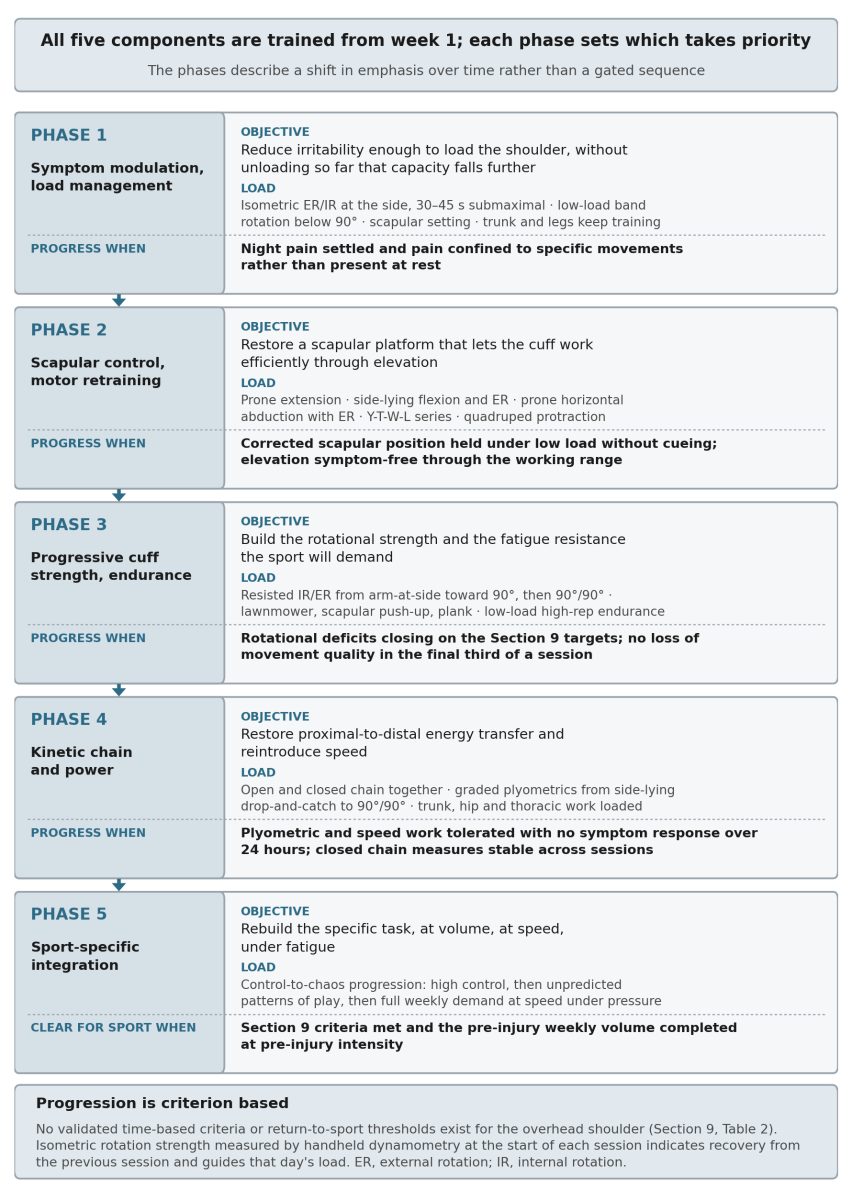
According to the 2022 Bern consensus, there is no fixed order for introducing kinetic chain work, scapular retraining and cuff strengthening; these components should be integrated from the outset, and the structure and timing of the programme depend on the driver of the dysfunction, whether pain, weakness or irritability [3]. The five phases below therefore describe a shift in emphasis over time. All components are trained from the first week, and each phase indicates which one receives priority. Figure 1 summarises the phases, the loading in each and the criteria for progression.
A quick isometric rotation test with the handheld dynamometer at the start of each session shows how the athlete has recovered from the previous one, and the result should guide that day’s load [3].
Phase 1: Symptom modulation and load management
The aim is to reduce irritability enough to load the shoulder, without unloading it so far that capacity falls further. Any overhead athlete with rotator cuff–related shoulder pain can start here.
Training continues in modified form: serving or throwing volume is reduced, and the athlete keeps training in the gym, pool or court on everything that does not provoke symptoms. Isometric external and internal rotation with the arm at the side comes first, each contraction held for 30 to 45 seconds at a submaximal effort the athlete can sustain without an increase in symptoms. Low-load band rotation below 90° of abduction can then be added, with scapular setting under manual and verbal guidance through protraction and retraction, elevation and depression, and upward and downward rotation, as at the start of the scapular retraining trial in this population [4]. The trunk, hips and legs continue to train normally.
Daily sessions are appropriate at this load, with two to three sets of isometric holds and one to two sets of 10 to 15 band repetitions. The upper limit is set by the symptom response over the following 24 hours, and not by symptoms during the session. The athlete moves to phase 2 when night pain has settled and pain is confined to specific movements, which is the boundary the Bern group draws between high and low irritability [3].
Phase 2: Scapular control and motor retraining
This phase restores a scapular platform that lets the cuff work efficiently through elevation. It begins once irritability is low by the criteria above.
The four-exercise programme tested in overhead athletes with mild impingement symptoms is a defensible starting set: prone extension from 90° of forward flexion to neutral; forward flexion in side lying to 90°; external rotation in side lying with a towel between elbow and trunk; and prone horizontal abduction with external rotation at the end of range [5].
The Y-T-W-L series adds position-specific work, performed prone on a ball or table: Y with elbows straight and thumbs up to bias lower trapezius, T with the scapula retracted to bias middle trapezius, W with elbows at 90° and the scapula drawn back and down, and L with the shoulder abducted to 90° and the forearm externally rotated [4].
Quadruped protraction and retraction is a closed chain option that loads serratus anterior with the hand fixed [4], and stretching should target the last degrees of arm elevation and upward scapular rotation [3].
The four-exercise programme ran for six weeks [5]. The scapular retraining trial used a 30-minute session in week one and 60-minute sessions from week two, three times per week [4]. Two to three sets of 10 to 15 repetitions per exercise is a reasonable working range at this load. The athlete progresses after producing and holding the corrected scapular position under low load without cueing, with elevation symptom-free through the working range; the source programme required completion of the previous exercises without pain or discomfort [4].
Phase 3: Progressive cuff strength and endurance
Phase 3 builds the rotational strength and the fatigue resistance the sport will demand, and starts once scapular control is achieved under low load.
Resisted internal and external rotation progresses from the arm-at-side position toward 90° of abduction and then to 90°/90° as tolerance allows [4]. Standing work with the arm elevated and the hand on a ball against the wall, with band resistance [3], and lawnmower, scapular push-up and plank progressions load the scapular stabilisers under increasing demand [4]. Endurance has to be trained specifically, because symptoms and loss of mechanics in overhead sport tend to appear late in a session; the post-surgical volleyball cohort used low-load, high-repetition isotonic work for this [6].
The proprioception trial in this population used three 60-minute sessions per week for eight weeks, with a 10-minute warm-up, perceived exertion progressed from 65% in weeks one and two to 75%, 85% and 90% in successive fortnights, and repetitions alternating between 10 and 12 [7]. A 12-week programme in baseball pitchers used a structured warm-up, work-out and cool-down in each session [8]. The two schemes have not been compared directly. The athlete moves on when rotational strength deficits are closing on the targets in Section 9 and movement quality holds through the final third of the session.
Phase 4: Kinetic chain and power
Phase 4 restores proximal-to-distal energy transfer and reintroduces speed. It starts when cuff strength and endurance are adequate for the loads planned.
Open and closed chain work are combined in the same sessions [3]. Plyometric work should begin in this phase at the latest and may start earlier; the Bern group regards early plyometric loading as important preparation for sport-specific load, beginning with low-load options such as small-amplitude drop-and-catch movements in side lying, then side-lying external rotation plyometrics with a ball, then fast concentric and slow eccentric external rotation at 90°/90° for throwing athletes [3]. High plank with external rotation at 90°/90°, push-up with backward walk, single-leg control, thoracic rotation and trunk work belong in the main part of the same sessions, under load [3].
Loading progresses from control to speed, and in this phase rate of force development matters more than peak force [3]. Total volume should be reduced in any week that introduces a new stimulus. The athlete moves on when plyometric and speed work cause no symptom response over the following 24 hours and closed chain measures are stable across sessions.
Phase 5: Sport-specific integration
The final phase rebuilds the specific task at volume, at speed and under fatigue, once the phase 4 criteria are met.
Single-plane work still has a place for a specific deficit, but the athlete must progress to complex multiplane and then sport-specific movement, performed with good quality, as soon as it is appropriate [3]. A control-to-chaos continuum gives this progression a structure: high control first, with range, speed and circumstances constrained, such as target throwing from a still start; then moderate chaos, with unpredicted movement and patterns of play; then high chaos, in which the athlete meets full weekly training demand including worst-case scenarios at high speed under one-on-one pressure [1]. After surgical repair in volleyball, this took the form of an interval spike programme, with the athlete playing without jumping for the first month [6].
Weekly load is increased by increments the athlete has shown they tolerate, tracked against the preceding four weeks [9]. Athletes with reduced external rotation strength or scapular dyskinesis tolerate smaller weekly increments than stronger athletes [3]. Clearance for sport requires the criteria in Section 9 and completion of the pre-injury weekly volume at pre-injury intensity.
Figure 1. Phase-based rehabilitation of rotator cuff–related shoulder pain in the overhead athlete. All components are trained from the first week; each phase indicates which receives priority [3]. The progression criterion of each phase is the entry criterion for the next. Progression is criterion based because no validated time-based criteria or return-to-sport thresholds exist for this population (Section 9, Table 2). ER, external rotation; IR, internal rotation.
6. Findings of the included studies
Table 1 summarises the seven studies. Across them, results depended mainly on what exercise was compared with.
Trials with no treatment or a weak comparator reported benefit. In 30 baseball pitchers with impingement symptoms, a 12-week programme reduced numeric rating scale (NRS) pain scores during strenuous activity from 7.88 to 3.56, whereas scores in the control group, which received no rehabilitation, moved from 7.71 to 8.00 [8]. In 33 overhead athletes with impingement syndrome, both sling and open kinetic chain training improved joint position sense compared with a control group that did not exercise (external rotation, F=44.76, p<0.001) [7]. In a three-arm trial of 45 athletes with rotator cuff tendinopathy, a physio-yogic programme reduced the total SPADI score by 20.3 points more than yoga asanas alone (p<0.0001) [10].
Comparisons between active programmes showed no clinically important difference on patient-reported outcomes. In the same trial, physio-yogic exercise was not superior to scapular recruitment exercise on any SPADI measure (total score difference 11.3 points, p=0.180; pain subscale p=0.184; disability subscale p=0.202) [10]. In 32 young male athletes with impingement and scapular dyskinesis, scapular dyskinesis–based exercise therapy maintained its gains at week 12 whereas the multimodal physical therapy group regressed, giving a between-group difference of 5.98 SPADI points (95% CI −7.85 to −4.12, p<0.001) [4]. This difference is smaller than every published SPADI threshold. The trial authors used a range of 14.1 to 20.6 points, which derives from patients after shoulder arthroplasty [4,11] and may not apply to young athletes with subacromial pain; the clinical practice guideline gives 8 points [2] and earlier validation work 8 to 13.2 points [12–14]. Multimodal therapy gave slightly more pain relief at week 8, 4.56 mm on a 100 mm visual analogue scale (VAS; p=0.018), well short of the 14 mm MCID [4,15]. One further statistically significant difference between active programmes concerned an impairment measure only: sling training produced smaller external rotation repositioning errors than open kinetic chain training (difference 3.18°, p=0.001), but no MCID exists for this measure and no clinical outcome was recorded [7].
Across the controlled trials, then, what a programme was compared with mattered more than what it contained. The physio-yogic trial shows this within a single randomised comparison: in the same 45 athletes, over the same eight weeks and on the same outcome measure, physio-yogic exercise outperformed yoga asanas by 20.3 SPADI points but not scapular recruitment exercise (11.3 points, p=0.180) [10]. Population, dose, setting and outcome definition were identical for both contrasts. Our reading is that supervised, progressively loaded exercise does most of the work and that the choice of exercises matters less than the loading, although trials this small could miss a modest difference between programmes.
The 2022 Bern consensus takes the same position, recommending that kinetic chain work, scapular training and cuff strengthening be integrated from the outset, with programme structure determined by the driver of the dysfunction [3]. Section 5 follows this approach and sets out priorities and decision criteria for each phase. None of the trials supports a claim that scapular dyskinesis–based therapy, physio-yogic exercise or any other named programme is superior to a well-delivered alternative.
The trials share several limitations. Samples were small, ranging from 21 to 45 participants in the conservative trials, and follow-up was short, extending at most four weeks beyond an eight-week intervention [4], too brief to capture a competitive season. The kinesiotaping trial enrolled 21 of the 48 participants required by its own sample size calculation and so could not exclude a small effect [16]; of its twelve between-group comparisons, one Western Ontario Rotator Cuff Index (WORC) subscale reached p=0.01, a result consistent with chance given the number of tests. In the physio-yogic trial, post hoc comparisons on the Athlete Life Quality Scale followed a non-significant analysis of variance (F=2.075, p=0.138), and the reported increase in abduction, from about 93° at baseline to 178° in all three arms, is difficult to reconcile with a population of competing athletes [10]. The trial is retained because its principal contribution here is a null comparison, and irregularities of this kind are more likely to inflate between-group differences than to conceal them. The proprioception trial recorded joint position sense only, with no pain, disability, return-to-sport or recurrence outcome [7], and the control group in the pitcher trial received no treatment, so that trial shows only that exercise is better than none [8]. The proprioception cohort of 33 athletes has also been described in other reports; only the three-arm report is cited, so that the same participants are not counted twice [7].
Table 1a. Characteristics of the included studies
Study, country
Design and level of evidence
Participants
Intervention vs comparator
Dose and duration
Cha 2014, Korea
Two-group trial; participants randomly divided; randomisation method, allocation concealment and blinding not reported
30 amateur baseball pitchers (16 exercise, 14 control), mean age 21.3 and 22.6 y, all male
12-week rehabilitation programme vs no rehabilitation
ANOVA on change scores: total SPADI F=4.343, p=0.019; ALQS F=2.075, p=0.138. Post hoc physio-yogic vs scapular recruitment: total SPADI 11.3 points, p=0.180; vs yoga asanas 20.3 points, p<0.0001
Physio-yogic vs scapular recruitment, 11.3 points: exceeds the 8-point threshold, below the 14.1–20.6 range, and not statistically significant. Physio-yogic vs yoga asanas, 20.3 points: exceeds all published thresholds
Not superior to the active comparator on any SPADI measure. Post hoc ALQS comparisons were reported after a non-significant ANOVA. Post-intervention range of motion values are difficult to reconcile with a competing athletic population
De Mey 2012
SPADI
29.86±17.03 → 11.70±13.78 (single group, n=40)
Not applicable; no comparator. Within-group p<0.001
Change of 18.16 points exceeds the 8-point and 8–13.2 thresholds and sits inside 14.1–20.6. The authors report 23 of 40 athletes individually exceeding the 8–13.2 threshold
Uncontrolled case series (Level 4). Improvement cannot be separated from natural history. Baseline score indicates a mildly symptomatic cohort
KJOC 31±12 → 89±11 at 6 months → 96 at 12 months. Pain 7.9±1.0 → 0.4±0.6 → 0.1±0.5. Return to sport 6.9±0.8 months; return to performance 12.4±1.9 months; 17/17 to pre-injury level
Not applicable; no comparator. KJOC p<0.001 and p=0.003; pain p<0.001 and p=0.02
KJOC change of 58 points exceeds the MDC of 6.7 points; no MCID is established for this instrument. Pain change of 7.5 points exceeds the 1.5-point MCID
Uncontrolled case series (Level 4), n=17, single institution, Olympic athletes, 82% partial-thickness tears. The return-to-training gate requiring operated-side external rotation above 50% of the healthy side was cleared by every athlete, observed range 70–138%
Qureshi 2024
Acromiohumeral distance at 0°
Acromiohumeral distance: taping 7.80±1.23 → 8.98±1.10; control 8.10±1.37 → 9.34±1.60. DASH 47.00±13.38 → 15.01±7.07 and 48.61±18.68 → 17.44±8.96
Acromiohumeral distance 0.365 mm, p=0.13; pain 0.309, p=0.98; DASH 2.345, p=0.39; WORC total 2.647, p=0.72
Within-group DASH changes of 31.99 and 31.17 exceed the 10.2-point MCID; pain changes of 1.60 and 1.73 exceed 1.5. Every between-group difference falls below its MCID. WORC thresholds are published on a different scale and were not applied
Recruited 21 of the 48 participants required by its sample size calculation, so a small effect cannot be excluded. One of twelve between-group comparisons reached p=0.01, consistent with chance
Saadatian 2022
Joint position sense absolute error, degrees
External rotation error: open chain 12.18±1.10 → 7.81±2.35; sling 11.18±2.08 → 4.09±2.45; control 10.27±3.10 → 11.18±2.52
No established MCID for joint position sense error in an athletic population
Impairment-only outcome set. No pain, disability, return-to-sport or recurrence outcome was collected, so a 3–8° change in repositioning error has no demonstrated clinical consequence. The control arm did no exercise
SPADI week 8 p=0.316; week 12 difference 5.98 points, 95% CI −7.85 to −4.12, p<0.001. Pain week 8 difference 4.56 mm favouring the comparator, p=0.018
Within-group changes exceed the thresholds the authors cite. The week-12 between-group difference of 5.98 points falls below every published SPADI threshold. The week-8 pain difference of 4.56 mm falls below the 14 mm threshold
Male athletes aged 18–25 only. Four-week follow-up cannot address a competitive season. The statistically significant week-12 difference is smaller than the smallest published threshold for the instrument
MCIDs applied: SPADI 8 points [2]; DASH 10.2 points [2]; pain VAS 1.5 points on a 0–10 scale [2] and 14 mm on a 0–100 mm scale [4,15]; pain NRS 1.1–6.3 points [2]. Other published SPADI thresholds are 8–13.2 points [12–14] and 14.1–20.6 points, the latter derived from patients after shoulder arthroplasty [11]. Published WORC thresholds, 275.7 points [2] and 282.6–588.7 points [11] on a 0–2100 scale, were not applied.
ALQS, Athlete Life Quality Scale; ANCOVA, analysis of covariance; ANOVA, analysis of variance; CI, confidence interval; DASH, Disabilities of the Arm, Shoulder and Hand; KJOC, Kerlan-Jobe Orthopaedic Clinic; MCID, minimal clinically important difference; MDC, minimal detectable change; NRS, numeric rating scale; SPADI, Shoulder Pain and Disability Index; VAS, visual analogue scale; WORC, Western Ontario Rotator Cuff Index.
7. Kinesiotaping as an adjunct
Kinesiotaping is inexpensive, quick to apply and widely used in athletic settings. One randomised trial has tested its added value in this population: twenty-one overhead athletes with rotator cuff tendinopathy received a six-week rehabilitation programme of ten supervised sessions and were randomised to receive functional kinesiotaping in addition or not [16]. Both groups improved by similar amounts. DASH scores fell by 31.99 points with taping and 31.17 points without, pain by 1.60 and 1.73 points, and acromiohumeral distance increased in both groups.
Between-group differences after treatment were small: 0.365 mm for acromiohumeral distance (p=0.13), 0.309 points for pain (p=0.98) and 2.345 points for disability (p=0.39) [16], all below the corresponding MCID.
Because the trial enrolled fewer than half the participants its sample size calculation required, it cannot exclude a small benefit from taping. What it does show is that the rehabilitation programme alone produced improvements larger than the MCID, and that adding tape made no measurable difference. Taping may still be reasonable if it helps an athlete tolerate training or feel more confident during return to play, provided it does not take time from the loading programme.
8. The post-operative pathway
Evidence on post-operative rehabilitation in this population is limited to one uncontrolled case series of 17 Olympic-level volleyball athletes who underwent arthroscopic supraspinatus repair after non-operative care had failed [6]. Fourteen of the 17 tears were partial-thickness, and the mean time from symptom onset to surgery was 11.3 months.
Kerlan-Jobe Orthopaedic Clinic (KJOC) scores rose from 31 before surgery to 89 at six months (p<0.001) and 96 at twelve months (p=0.003 versus six months). Pain after intense exercise fell from 7.9 to 0.4 at six months (p<0.001) and to 0.1 at twelve months (p=0.02 versus six months). All 17 athletes returned to their pre-injury level, at a mean of 6.9 months to sport and 12.4 months to performance [6].
The authors report an MDC of 6.7 points for the KJOC score. An MDC shows that an observed change exceeds measurement error but not that it matters to the patient, which is what an MCID captures. No published MCID for the KJOC score was identified, so the 58-point improvement can be regarded as real, but its clinical importance cannot be quantified.
For clinicians, the rehabilitation protocol used in this cohort may be more informative than its outcome data. Passive mobilisation and warm-water pool work began at three weeks. Weeks six to ten emphasised assisted and passive range of motion, joint mobilisation and scapular control, with early exercises kept submaximal and below 90° of abduction. Weeks ten to sixteen introduced elastic-band strengthening, dynamic stabilisation, plyometrics and endurance work at low load and high repetition. From week sixteen, an interval spike programme began, with volleyball played without jumping for the first month [6].
This was a Level 4 case series of 17 athletes from a single institution, 14 of whom had partial-thickness tears, so the findings apply mainly to partial-tear repair in elite athletes. Every athlete also cleared the return-to-training criterion, operated-side external rotation strength above 50% of the healthy side, by a wide margin (observed range 70% to 138%). Because the criterion did not distinguish between athletes, these data cannot show whether it is a useful clearance threshold.
9. Return-to-sport decision framework
Return to sport is a continuum with three elements: return to participation, in which the athlete trains in a modified way; return to sport, in which the athlete competes below the previous level; and return to performance, in which the athlete plays a full match or throws the pre-injury volume at the pre-injury velocity [9]. Table 2 sets out 22 criteria across these three elements and the six domains agreed at Bern: pain; active range of motion; strength, power and endurance; kinetic chain; psychological readiness; and sport-specific demand [3].
None of the guideline or consensus sources reviewed provides a validated return-to-sport threshold for the overhead shoulder, and the Bern group reports that no single test or test battery has been validated for this decision after shoulder injury [3]. Of the 22 criteria in Table 2, two are MCIDs, which show whether a patient perceives a change but say nothing about readiness to compete; three are symmetry or ratio targets with inconsistent published ranges; two are normative values from uninjured athletes that have not been validated as pass marks; eight record that no threshold exists or that consensus was not reached; and seven describe measurement methods or decision processes.
A few numerical targets are available. Total rotational range of motion should be within 10% of the contralateral side, with a side difference in internal rotation of less than 20° and external rotation 5° to 10° greater on the dominant side [1,3]. Dominant-side rotator cuff strength is typically about 10% greater than on the non-dominant side, with an MDC of 10 to 15 N on handheld dynamometry [1]. External-to-internal rotation strength ratios depend on test position: 70% to 75% at 0°/0°, 100% at 90°/0° and 60% to 85% at 90°/90° [1]. The test position should be recorded with every value, and absolute strength reported alongside the ratio, because an athlete who is uniformly weak can still have a normal ratio [3].
Overhead athletes may return to participation with some pain, and the Bern group did not reach consensus on whether they should be pain free before returning to sport. They should, however, be pain free before attempting to return to performance [3], which is the only unambiguous pain criterion in the framework.
None of the guideline or consensus sources provides validated time-based criteria for this population either. The mean times of 6.9 and 12.4 months after surgical repair are outcomes observed in 17 elite athletes and have not been validated as milestones [6].
In practice, the clinician works through each domain, records what was measured and the result, and clears the athlete when the combined assessment of tissue health and tissue stress falls within the level of risk the situation allows, sharing the decision with the athlete and coach [9]. The table records which domains were assessed, on what evidence and where clinical judgement was required, so the decision can be reviewed later.
Table 2. Criteria-based return-to-sport framework for the overhead athlete
Element and milestone
Domain
Criterion and threshold
How measured
Source
Basis
1. Return to participation
1.1 Pain controlled enough to load
Pain
Overhead athletes may return to participation while still in pain; no numeric ceiling is set
Worst pain NRS during, after and the day after training
[3]
None
1.2 Symptom response tracked over time
Pain
At least 1.5 points on a 0–10 visual analogue scale. Numeric rating scale range is 1.1–6.3 and too wide to gate on
Same instrument every visit
[2]
MCID
1.3 Disability moves, not just pain
Function
At least 8 points on SPADI or 10.2 on DASH
Same instrument every visit
[2]
MCID
1.4 Range of motion monitored, not gated
ROM
Full range is not required at this stage
Goniometry, standardised position
[3]
None
1.5 Strength measured objectively from the outset
Strength
Handheld dynamometry, not manual muscle testing; normalise to body weight
HHD; record test position with every value
[2,3]
Method
1.6 Training load tracked from the first session
Load
Current training week against the mean of the preceding four weeks. No shoulder-specific safe band exists
Pitch or serve count, velocity, session RPE
[9]
Method
2. Return to sport
2.1 Pain state before unrestricted sport
Pain
No agreed criterion for overhead athletes; consensus was not reached
Worst pain NRS during and after sport-specific drills
[3]
None
2.2 Range of motion restored
ROM
Full range should be restored before return to sport; no numeric target accompanies the recommendation
Goniometry
[3]
Method
2.3 Rotational range symmetry
ROM
Total rotational range within 10% of the contralateral side; internal rotation side difference under 20°; external rotation 5–10° greater on the dominant side
Goniometry at 90° abduction, supine, scapula stabilised; MDC 5°
[1,3]
Symmetry/ratio
2.4 Rotator cuff strength symmetry
Strength
Dominant side approximately 10% above non-dominant; MDC 10–15 N
HHD, standardised position, normalised to body weight
[1,3]
Symmetry/ratio
2.5 External-to-internal rotation ratio
Strength
Position-dependent: 70–75% at 0°/0°; 100% at 90°/0°; 60–85% at 90°/90°. Sources also report 63–72% isokinetic and 75–100% isometric. No universal ratio is endorsed
Isokinetic dynamometry or HHD break test; report absolute strength alongside the ratio
[1,3]
Symmetry/ratio
2.6 Rotator cuff endurance
Endurance
No numeric threshold published. Recommended tests only
Posterior Shoulder Endurance Test; external rotation endurance at 90°/90°; side plank
[3]
None
2.7 Closed-chain upper-limb capacity
Kinetic chain
CKCUEST 20 touches (women) and 27 (men), MDC 3.4; Y-Balance upper quarter composite 81 cm and 89 cm, MDC 4.5 cm
CKCUEST 15 s; YBT-UQ composite
[1]
Normative
2.8 Upper-limb power
Kinetic chain
Seated medicine-ball throw 236 cm (women) and 310 cm (men), MDC 30 cm
NRS during, after and the day after full-intensity sport
[3]
Method
3.2 Volume and velocity restored
Sport-specific
Pain-free throws or serves at or above previous speed, benchmarked to the athlete’s own pre-injury values
Count with velocity measurement; video review
[3]
Method
3.3 Sport- and position-specific demand met
Sport-specific
No numeric threshold; demands differ by playing position within a sport
Clinician-selected sport-specific battery
[3]
None
3.4 The decision itself
All
Clear when tissue health and tissue stresses together sit below the risk tolerance the situation permits; shared decision
Three-step risk and risk-tolerance framework
[9]
Method
3.5 After arthroscopic supraspinatus repair
Sport-specific / strength
Return-to-training gate used in one elite cohort: operated-side external rotation above 50% of the healthy side, and external rotation reaching 66% of internal rotation. Observed outcomes: return to sport 6.9±0.8 months, return to performance 12.4±1.9 months
Isometric internal and external rotation dynamometry, seated, arm adducted, elbow at 90°, averaged across −20°, 0° and +20°
[6]
Level 4
Grouped by the three elements of the return-to-sport continuum [9] and the six domains agreed at Bern [3]. Evidence basis: MCID = derived from a published minimal clinically important difference; Symmetry/ratio = target whose published range is disputed; Normative = reference value in uninjured athletes, not a validated pass mark; Method = measurement or decision guidance; None = no threshold exists or consensus was not reached; Level 4 = from an uncontrolled case series.
10. Evidence gaps and research priorities
Five gaps in the evidence limit practice.
The most important is the absence of a validated return-to-sport criterion for the overhead shoulder in the guideline and consensus sources reviewed. Prospective cohorts that record candidate thresholds at clearance and follow recurrence across a full season are needed; until such data are available, clearance decisions will depend partly on unquantified clinical judgement.
Follow-up is also short. The longest in the conservative trials reviewed here is four weeks beyond the intervention [4], and no included trial measured recurrence under renewed competitive load, which is the outcome athletes and clinicians care about.
Outcome selection is a further problem. The proprioception trial recorded joint position sense only, with no pain, disability or sport outcome [7]. Impairment measures are inexpensive and reproducible, and they are most useful when reported with patient-reported and sport-specific outcomes.
Comparator choice explains much of the reported benefit. Trials that showed benefit compared exercise with no treatment or a weak alternative, whereas trials with a credible active comparator found no difference exceeding published thresholds. Future trials can reasonably assume that supervised progressive exercise is effective and address more specific questions about dose, the driver of symptoms and timing within the season.
The populations studied are narrow. The best-reported trial enrolled only men aged 18 to 25 [4]; women, adolescent athletes and masters athletes are largely absent from this evidence base, and the sports represented are concentrated in a few disciplines.
Reporting could also be improved. Published MCIDs for the SPADI vary more than twofold across sources, and thresholds for two near-identical 0–10 pain scales, the VAS and the NRS, differ by a similar margin [2]. Trials should state which threshold they use and justify its relevance to the population studied.
11. Limitations of this review
No structured database search was performed for this review, no protocol was registered, studies were not screened in duplicate and no formal risk-of-bias tool was applied, so relevant studies may have been missed. The evidence base is small, with conservative trials enrolling 21 to 45 participants, short follow-up and a predominance of young male athletes from a few sports. Some included reports contained numerical inconsistencies between text and tables, which limits the precision of the extracted values. Some MCID values were taken secondhand, from the guideline and trial reports that cite them, and published thresholds for the same instrument vary.
Neither the phase structure in Section 5 nor the criteria in Table 2 has been tested prospectively against recurrence or successful return to sport. Both organise existing guidance and measurements for clinical use and will require validation in athletic cohorts.
12. Conclusion
Supervised, progressively loaded exercise improves pain and function in overhead athletes with rotator cuff–related shoulder pain, at least when compared with no treatment or a weak comparator. Which programme is used seems to matter much less. No specific exercise programme has outperformed another credible programme on patient-reported outcomes, which fits the 2022 Bern consensus recommendation that kinetic chain, scapular and cuff training be integrated according to the driver of the athlete’s dysfunction [3].
What clinicians lack is a way to sequence and progress that loading, and the phase-based framework and criteria presented here are meant to fill that gap. The return-to-sport decision is harder. No validated threshold exists for this population, so clearance still rests on clinical judgement; recording the domains assessed and the evidence behind each at least allows that judgement to be checked later.
Abbreviations
ALQS, Athlete Life Quality Scale; ANCOVA, analysis of covariance; ANOVA, analysis of variance; CI, confidence interval; CKCUEST, Closed Kinetic Chain Upper Extremity Stability Test; DASH, Disabilities of the Arm, Shoulder and Hand questionnaire; ER, external rotation; HHD, handheld dynamometry; IR, internal rotation; KJOC, Kerlan-Jobe Orthopaedic Clinic score; MCID, minimal clinically important difference; MDC, minimal detectable change; NRS, numeric rating scale; ROM, range of motion; RPE, rating of perceived exertion; SPADI, Shoulder Pain and Disability Index; VAS, visual analogue scale; WORC, Western Ontario Rotator Cuff Index; YBT-UQ, Y-Balance Test, upper quarter.
Declarations
Funding: This research received no specific grant from any funding agency in the public, commercial or not-for-profit sectors.
Conflicts of interest: The authors declare no conflicts of interest.
Author contributions: Abdulrahman M Alquraynis: conceptualization, methodology, supervision, project administration, validation, and writing (review and editing). Abdullah K Abusoliman: conceptualization, methodology, project administration, investigation, data curation, writing (original draft), and writing (review and editing). Alanoud H Alruqi: methodology, investigation, data curation, formal analysis, and writing (original draft). Yazeed A Asery: investigation, data curation, literature review, and writing (original draft). Reem A Alshehri: investigation, data collection, data curation, and writing (original draft). Eyad S Alhashim: methodology, formal analysis, interpretation of results, and writing (review and editing). Abdulaziz A Alnuwaysir: investigation, data curation, formal analysis, and writing (original draft). Ahmed A Alzahrani: literature review, investigation, data collection, and writing (original draft). Luay M Almutair: literature review, data collection, data curation, and writing (original draft). Ibrahim E Almaski: investigation, data collection, literature review, and writing (original draft). Suliman A Alluhib: investigation, data curation, interpretation of results, and writing (review and editing). Razan M Albalawi: literature review, data collection, and writing (original draft). Ibtisam A Mohammed: investigation, data curation, literature review, and writing (original draft). Ali M Alqahtani: investigation, data collection, literature review, and writing (original draft). Ahmed A Hejazi: literature review, data collection, and writing (original draft). All authors approved the final version of the manuscript.
Data availability: All data discussed in this review are contained within the cited published articles. The extraction tables underlying Tables 1a, 1b and 2, including the source location of every value, are available from the corresponding author on reasonable request.
Ethics approval: Not applicable. This review used only previously published data and involved no human participants, human tissue or identifiable personal data.
Use of generative AI: During editorial revision, the manuscript was restructured and redrafted with the assistance of Claude (Anthropic), which was also used to prepare Figure 1. Extracted values and references were checked against the original publications. The authors reviewed and approved the final version and take full responsibility for its content.
Acknowledgements: None.
References
Cools AM, Maenhout AG, Vanderstukken F, Declève P, Johansson FR, Borms D. The challenge of the sporting shoulder: from injury prevention through sport-specific rehabilitation toward return to play. Ann Phys Rehabil Med. 2021;64(4):101384. doi:10.1016/j.rehab.2020.03.009
Desmeules F, Roy JS, Lafrance S, Charron M, Dubé MO, Dupuis F, et al. Rotator cuff tendinopathy diagnosis, nonsurgical medical care, and rehabilitation: a clinical practice guideline. J Orthop Sports Phys Ther. 2025;55(4):235–274. doi:10.2519/jospt.2025.13182
Schwank A, Blazey P, Asker M, Møller M, Hägglund M, Gard S, et al. 2022 Bern consensus statement on shoulder injury prevention, rehabilitation, and return to sport for athletes at all participation levels. J Orthop Sports Phys Ther. 2022;52(1):11–28. doi:10.2519/jospt.2022.10952
Wen M, Hu X, Bao G. Scapular dyskinesis-based exercise therapy versus multimodal physical therapy for subacromial impingement syndrome in young overhead athletes with scapular dyskinesis: a randomized controlled trial. BMC Sports Sci Med Rehabil. 2025;17(1):204. doi:10.1186/s13102-025-01254-8
De Mey K, Danneels L, Cagnie B, Cools AM. Scapular muscle rehabilitation exercises in overhead athletes with impingement symptoms: effect of a 6-week training program on muscle recruitment and functional outcome. Am J Sports Med. 2012;40(8):1906–1915. doi:10.1177/0363546512453297
Porcellini G, Ziroglu N, De Santis E, Micheloni GM, Tarallo L, Giorgini A. Midterm clinical outcomes after arthroscopic rotator cuff repair in Olympic volleyball players: return to sports and return to performance. Orthop J Sports Med. 2023;11(8):23259671231186820. doi:10.1177/23259671231186820
Saadatian A, Babaei Khorzoghi M, Sahebozamani M, Karimi MT. The impact of OKC exercises and TRX exercises on shoulder joint proprioception in overhead athletes with shoulder impingement syndrome: a randomized controlled trial. Phys Treat. 2022;12(2):77–84.
Cha JY, Kim JH, Hong J, Choi YT, Kim MH, Cho JH, et al. A 12-week rehabilitation program improves body composition, pain sensation, and internal/external torques of baseball pitchers with shoulder impingement symptom. J Exerc Rehabil. 2014;10(1):35–44. doi:10.12965/jer.140087
Ardern CL, Glasgow P, Schneiders A, Witvrouw E, Clarsen B, Cools A, et al. 2016 consensus statement on return to sport from the First World Congress in Sports Physical Therapy, Bern. Br J Sports Med. 2016;50(14):853–864. doi:10.1136/bjsports-2016-096278
Chawla JK, Chandra I, Sharma R, Verma S, Kumar P, Sharma V, et al. Integrating physio-yogic exercises for rotator cuff tendinopathy in Indian overhead athletes: a comprehensive approach. J Lifestyle Med. 2024;14(1):46–53. doi:10.15280/jlm.2024.14.1.46
Dabija DI, Jain NB. Minimal clinically important difference of shoulder outcome measures and diagnoses: a systematic review. Am J Phys Med Rehabil. 2019;98(8):671–676. doi:10.1097/PHM.0000000000001169
Heald SL, Riddle DL, Lamb RL. The Shoulder Pain and Disability Index: the construct validity and responsiveness of a region-specific disability measure. Phys Ther. 1997;77(10):1079–1089.
Roy JS, MacDermid JC, Woodhouse LJ. Measuring shoulder function: a systematic review of four questionnaires. Arthritis Rheum. 2009;61(5):623–632.
Williams JW Jr, Holleman DR Jr, Simel DL. Measuring shoulder function with the Shoulder Pain and Disability Index. J Rheumatol. 1995;22(4):727–732.
Tashjian RZ, Deloach J, Porucznik CA, Powell AP. Minimal clinically important differences (MCID) and patient acceptable symptomatic state (PASS) for visual analog scales (VAS) measuring pain in patients treated for rotator cuff disease. J Shoulder Elbow Surg. 2009;18(6):927–932. doi:10.1016/j.jse.2009.03.021
Qureshi H, Omer A, Khan A, Rauf U, Ahmad U, Ur Rehman MM. The effects of functional kinesiotaping on acromio humeral distance, pain, quality of life and disability in overhead athletes with rotator cuff tendinopathy: a randomized control trial. Adv Rehabil. 2024;38(4):25–33. doi:10.5114/areh.2024.144634