Parental Awareness of and Response to Symptoms of Hypoglycemia and Diabetic Ketoacidosis in Children with Type 1 Diabetes in Tabuk, Saudi Arabia: A Cross-Sectional Study
Introduction
Type 1 diabetes (T1D) is a chronic autoimmune disease in which destruction of the pancreatic β-cells causes absolute insulin deficiency and lifelong dependence on exogenous insulin [1]. Saudi Arabia has one of the highest incidence rates of childhood T1D in the world [2], estimated at 31.4 per 100,000 children younger than 15 years per year in 2021 [3], so a large number of Saudi families manage the disease at home every day.
Hypoglycemia and diabetic ketoacidosis (DKA) are the main acute complications of T1D in children, and young children are particularly vulnerable to their neurological effects [4]. Hypoglycemia produces adrenergic symptoms such as shakiness, palpitations and sweating, and neuroglycopenic symptoms such as headache, drowsiness and poor concentration, and severe episodes can cause seizures or loss of consciousness [5]. It is usually precipitated by excess insulin, missed meals or exercise, and a conscious child should be given fast-acting glucose and have the blood glucose re-tested after 15 minutes [5]. DKA results from absolute or relative insulin deficiency. Its clinical features include nausea, vomiting, abdominal pain, deep sighing (Kussmaul) respiration and drowsiness [6], and it is usually preceded by the polyuria and polydipsia of uncontrolled hyperglycemia. Cerebral injury complicates 0.5–0.9% of pediatric DKA episodes and carries a mortality of 21–24% [6], and in a national series from the United Kingdom, DKA was implicated in most diabetes-related deaths among children and young people [7]. Missed insulin doses and intercurrent illness are the usual triggers [6,8]. Sick-day management at home, which means never stopping insulin, giving supplementary insulin, monitoring glucose and ketones and contacting the diabetes team early, can prevent progression to DKA [8]. In Saudi studies, 38–45% of children had DKA when T1D was diagnosed [9,10], and in Riyadh 45.6% of adolescents admitted with DKA had recurrent episodes, almost all after stopping insulin or during infection [11].
Young children often cannot recognize or report hypoglycemia [4], so parents are responsible for glucose monitoring, insulin administration and acting on warning signs. Parents’ diabetes knowledge has been linked to better glycemic control in their children [12,13], and many parents report a high fear of hypoglycemia [14]. Surveys in Saudi Arabia have found important gaps in caregivers’ knowledge of DKA [15,16]. In the Tabuk region, a 2021 survey of Saudi parents found limited awareness of DKA symptoms, but it excluded non-Saudi families and did not address hypoglycemia [17]. Less is known about parents’ recognition of hypoglycemia or about what they would do when either emergency occurs.
We therefore assessed parents’ knowledge of the symptoms and precipitating factors of hypoglycemia and DKA in children with T1D in Tabuk, their intended responses to each emergency, and the sociodemographic and clinical factors associated with adequate knowledge.
Methods
Study design and setting
This cross-sectional, questionnaire-based study was conducted in Tabuk city, northwestern Saudi Arabia, among parents of children with T1D who were receiving follow-up at healthcare facilities in Tabuk that provide routine care for children with diabetes. The study is reported in accordance with the Strengthening the Reporting of Observational Studies in Epidemiology (STROBE) statement [18], and the online survey is described with reference to the Checklist for Reporting Results of Internet E-Surveys (CHERRIES) [19].
Participants
Eligible participants were mothers, fathers or other primary caregivers who were directly responsible for the daily diabetes management of a child younger than 18 years with T1D, who lived in Tabuk or attended diabetes follow-up there, and who gave electronic informed consent. Caregivers who were not directly responsible for the child’s diabetes care, or whose child had a type of diabetes other than T1D, were excluded.
Sample size and sampling
The minimum sample size was calculated with Cochran’s formula for a single proportion, n = Z²p(1 − p)/d² [20], assuming an expected proportion of adequate knowledge of 50% (the value that gives the largest sample), a 95% confidence level (Z = 1.96) and a 5% margin of error. This gave 384.16, which was rounded to 384 participants. Participants were recruited through the participating facilities. The sampling frame and the number of caregivers invited were not recorded, so this was a non-probability sample, and a response rate could not be calculated.
Questionnaire
A structured, self-administered questionnaire in Arabic was used. It had three sections. The first recorded the child’s nationality, age, sex and school level; each parent’s age, education and occupation; the duration of diabetes; and the number of daily insulin injections. The second covered hypoglycemia: recognition of five symptoms and three precipitating factors, the action the respondent would take (give a sugary drink, check blood glucose, take the child to hospital, or do nothing), and whether they considered hypoglycemia dangerous. The third covered DKA in the same way, with nine symptoms and signs, three precipitating factors and four possible actions (give insulin, check blood glucose, take the child to hospital, or do nothing). The individual items are listed in Tables 2 and 3. Respondents could select more than one option for the symptom, precipitating-factor and action questions. The questions offered no “do not know” option, and the questionnaire was not formally validated before use.
Data collection
Data were collected between 31 May and 19 October 2025. Research coordinators at the participating facilities informed eligible caregivers about the study and gave them the link to the questionnaire, which was hosted on Google Forms. The opening page explained the purpose of the study, that participation was voluntary and anonymous, and that completion would take 10–15 minutes, and asked respondents to confirm their consent. No names, contact details or other identifiers were collected. Submission of the form marked the end of participation.
Knowledge scoring
For each condition, one point was given for every symptom and every precipitating factor the respondent selected. Because all listed options were correct, the maximum score was 8 for hypoglycemia (five symptoms and three precipitating factors) and 12 for DKA (nine symptoms and three precipitating factors). Every respondent selected at least one symptom and one precipitating factor for each condition, so the lowest observed score was 2 on both scales. A score of at least 50% of the maximum (≥ 4 for hypoglycemia and ≥ 6 for DKA) was classified as adequate knowledge, and lower scores as inadequate; a similar threshold (above 50%) has been used in a previous study of diabetes knowledge among caregivers [21]. The intended actions and the perceived danger of each condition were analyzed descriptively and did not contribute to the scores.
Data cleaning
The survey received 383 responses. We excluded 3 respondents who answered “No” to the consent question and 4 duplicate submissions, defined as responses identical to an earlier response on every item (three of the four were submitted within 3 minutes of the first). The remaining 376 responses had no missing data and were all analyzed.
Statistical analysis
Categorical variables are presented as frequencies and percentages, and knowledge scores as mean ± standard deviation (SD) and median with interquartile range (IQR). The correlation between the two knowledge scores was assessed with Spearman’s rank correlation coefficient (ρ). Associations between participant characteristics and adequate knowledge were first examined with Pearson’s chi-square test without continuity correction, with no adjustment for multiple comparisons. Two multivariable binary logistic regression models, one for adequate knowledge of hypoglycemia and one for adequate knowledge of DKA, were then fitted. Both models included all sociodemographic and clinical characteristics entered simultaneously, except the child’s school level, which was omitted because of its collinearity with the child’s age. Unadjusted odds ratios (OR) were obtained from univariable logistic regression, and the multivariable results are reported as adjusted odds ratios (AOR), each with a 95% confidence interval (CI). Calibration was assessed with the Hosmer–Lemeshow test (deciles of predicted probability), explained variation with Nagelkerke R², and discrimination with the C-statistic (area under the receiver operating characteristic curve); each model had approximately 10 events per estimated parameter. In a sensitivity analysis, both scores were analyzed as continuous outcomes with multiple linear regression using heteroscedasticity-robust (HC3) standard errors; the regression coefficient (b) is the adjusted difference in score points. A two-sided p < 0.05 was considered statistically significant. Analyses were performed in Python 3.13 with the pandas, SciPy and statsmodels libraries.
Ethical considerations
The study was approved by the Research Ethics Committee of the University of Tabuk (approval no. UT-533-358-2025, 19 March 2025) and confirmed by the Tabuk Institutional Review Board (protocol no. TU-077/025/319, 30 April 2025), and it was conducted in accordance with the Declaration of Helsinki. All analyzed participants gave electronic informed consent before answering the questionnaire. The data were stored securely and accessed only by the research team.
Results
Participant characteristics
Of the 383 responses received, 376 were analyzed after the exclusion of 3 respondents who declined consent and 4 duplicate submissions. Most children were Saudi (n = 343, 91.2%), aged 10 to <18 years (n = 293, 77.9%) and female (n = 227, 60.4%), and 257 (68.4%) were in intermediate or secondary school. Most mothers (n = 281, 74.7%) and fathers (n = 245, 65.2%) were aged 30–50 years; 241 (64.1%) mothers had a university or postgraduate education and 201 (53.5%) were housewives, while most fathers were government employees (n = 267, 71.0%). Diabetes had been diagnosed at least 1 year earlier in 279 (74.2%) children. Two daily insulin injections were used by 168 (44.7%) children, three by 135 (35.9%) and four by 73 (19.4%) (Table 1).
Table 1. Characteristics of the children with type 1 diabetes and their parents (n = 376)
| Characteristic | n (%) |
|---|
| Nationality of the child |
| Saudi | 343 (91.2) |
| Non-Saudi | 33 (8.8) |
| Child’s age |
| <10 years | 83 (22.1) |
| 10 to <18 years | 293 (77.9) |
| Child’s sex |
| Male | 149 (39.6) |
| Female | 227 (60.4) |
| Child’s school level |
| Pre-primary | 27 (7.2) |
| Primary | 92 (24.5) |
| Intermediate | 111 (29.5) |
| Secondary | 146 (38.8) |
| Mother’s age |
| <30 years | 50 (13.3) |
| 30–50 years | 281 (74.7) |
| >50 years | 45 (12.0) |
| Mother’s education |
| School (general) education | 135 (35.9) |
| University | 212 (56.4) |
| Postgraduate | 29 (7.7) |
| Mother’s occupation |
| Housewife | 201 (53.5) |
| Employed | 175 (46.5) |
| Father’s age |
| <30 years | 17 (4.5) |
| 30–50 years | 245 (65.2) |
| >50 years | 114 (30.3) |
| Father’s education |
| School (general) education | 172 (45.7) |
| University | 164 (43.6) |
| Postgraduate | 40 (10.6) |
| Father’s occupation |
| Government employee | 267 (71.0) |
| Private-sector employee | 44 (11.7) |
| Self-employed | 65 (17.3) |
| Duration of diabetes |
| <1 year | 97 (25.8) |
| ≥1 year | 279 (74.2) |
| Daily insulin injections |
| Two | 168 (44.7) |
| Three | 135 (35.9) |
| Four | 73 (19.4) |
Child characteristics (nationality, age, sex, school level) were reported by the responding parent.
Knowledge of and responses to hypoglycemia
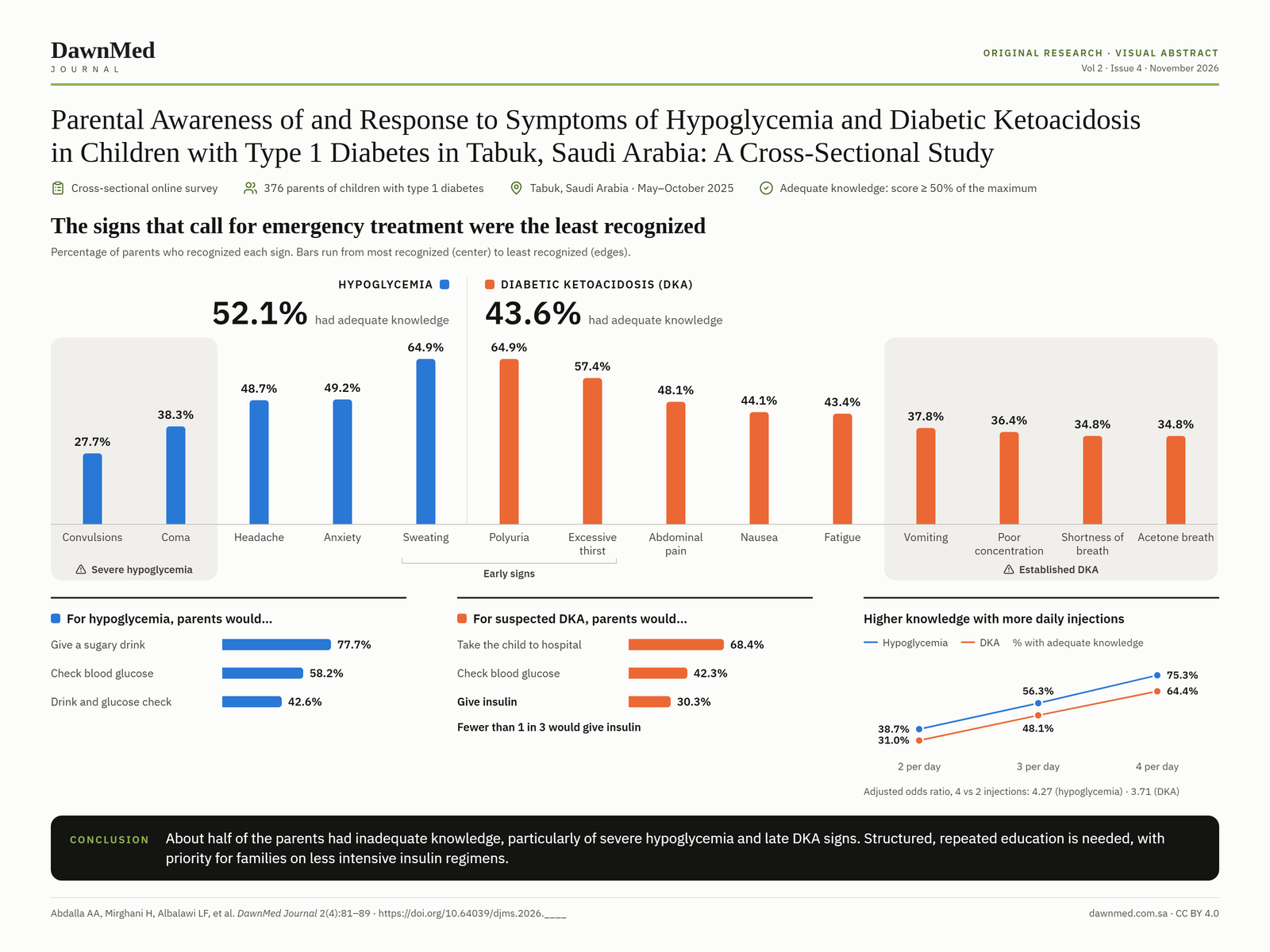
Sweating was the symptom of hypoglycemia recognized most often (n = 244, 64.9%), followed by anxiety (n = 185, 49.2%) and headache (n = 183, 48.7%). Fewer parents recognized coma (n = 144, 38.3%) or convulsions (n = 104, 27.7%), and only 29 (7.7%) parents recognized all five symptoms. Skipping a meal was identified as a precipitating factor by 300 (79.8%) parents, compared with 183 (48.7%) for a higher insulin dose and 105 (27.9%) for exercise. If their child had hypoglycemia, 292 (77.7%) parents would give a sugary drink and 219 (58.2%) would check the blood glucose; 160 (42.6%) would do both. Taking the child to hospital was chosen by 74 (19.7%) parents, 53 of whom would also give a sugary drink, and 14 (3.7%) chose hospital as their only action. Nineteen parents (5.1%) ticked “do nothing”, 9 of them alongside an active response. Hypoglycemia was considered dangerous by 331 (88.0%) parents. The mean hypoglycemia knowledge score was 3.85 ± 1.71 out of 8 (median 4, IQR 2–5), and 196 (52.1%) parents had adequate knowledge (Table 2).
Table 2. Parents’ knowledge of hypoglycemia, intended responses and perceived danger (n = 376)
| Item | n (%) |
|---|
| Symptoms recognized as signs of hypoglycemiaa |
| Sweating | 244 (64.9) |
| Anxiety | 185 (49.2) |
| Headache | 183 (48.7) |
| Coma | 144 (38.3) |
| Convulsions | 104 (27.7) |
| Precipitating factors recognizeda |
| Skipping a meal | 300 (79.8) |
| Higher insulin dose | 183 (48.7) |
| Exercise | 105 (27.9) |
| Action the parent would take when the child has hypoglycemiaa |
| Give a sugary drink | 292 (77.7) |
| Check blood glucose | 219 (58.2) |
| Take the child to hospital | 74 (19.7) |
| Do nothing | 19 (5.1) |
| Selected combinations of actions |
| Give a sugary drink and check blood glucose | 160 (42.6) |
| Take the child to hospital as the only action | 14 (3.7) |
| Do nothing as the only answer | 10 (2.7) |
| Considers hypoglycemia dangerous |
| Yes | 331 (88.0) |
| No | 45 (12.0) |
| Knowledge score (maximum 8)b |
| Mean ± SD | 3.85 ± 1.71 |
| Median (IQR) | 4 (2–5) |
| Adequate knowledge (score ≥ 4), n (%) | 196 (52.1) |
aMultiple responses were allowed; percentages are of all 376 participants and do not add up to 100%. Items are listed in descending order of frequency. bOne point for each symptom and precipitating factor selected; every respondent selected at least one of each, so the lowest observed score was 2. SD, standard deviation; IQR, interquartile range.
Knowledge of and responses to diabetic ketoacidosis
Polyuria (n = 244, 64.9%) and excessive thirst (n = 216, 57.4%) were the most frequently recognized symptoms of DKA, followed by abdominal pain (n = 181, 48.1%), nausea (n = 166, 44.1%) and fatigue (n = 163, 43.4%). Vomiting (n = 142, 37.8%), poor concentration (n = 137, 36.4%), shortness of breath (n = 131, 34.8%) and acetone breath odor (n = 131, 34.8%) were each recognized by about one-third of parents, and 36 (9.6%) recognized all nine. Missing insulin doses was identified as a cause of DKA by 241 (64.1%) parents, insufficient insulin doses by 153 (40.7%) and intercurrent illness by 152 (40.4%). If signs of DKA appeared, 257 (68.4%) parents would take the child to hospital, and 156 (41.5%) chose hospital as their only action. Checking the blood glucose was chosen by 159 (42.3%) parents and giving insulin by 114 (30.3%); 203 (54.0%) would do at least one of these. Doing nothing was ticked by 20 (5.3%) parents, 6 of whom also selected an active response. DKA was considered dangerous by 352 (93.6%) parents. The mean DKA knowledge score was 5.47 ± 2.97 out of 12 (median 5, IQR 3–7), and 164 (43.6%) parents had adequate knowledge (Table 3). The hypoglycemia and DKA knowledge scores were strongly correlated (ρ = 0.68, p < 0.001), and 133 (35.4%) parents had adequate knowledge of both conditions.
Table 3. Parents’ knowledge of diabetic ketoacidosis, intended responses and perceived danger (n = 376)
| Item | n (%) |
|---|
| Symptoms and signs recognized as signs of DKAa |
| Polyuria | 244 (64.9) |
| Excessive thirst | 216 (57.4) |
| Abdominal pain | 181 (48.1) |
| Nausea | 166 (44.1) |
| Fatigue | 163 (43.4) |
| Vomiting | 142 (37.8) |
| Poor concentration | 137 (36.4) |
| Shortness of breath | 131 (34.8) |
| Acetone (fruity) breath odor | 131 (34.8) |
| Precipitating factors recognizeda |
| Missing insulin doses | 241 (64.1) |
| Insufficient insulin doses | 153 (40.7) |
| Intercurrent illness | 152 (40.4) |
| Action the parent would take when signs of DKA appeara |
| Take the child to hospital | 257 (68.4) |
| Check blood glucose | 159 (42.3) |
| Give insulin | 114 (30.3) |
| Do nothing | 20 (5.3) |
| Selected combinations of actions |
| Give insulin or check blood glucose (either or both) | 203 (54.0) |
| Take the child to hospital as the only action | 156 (41.5) |
| Do nothing as the only answer | 14 (3.7) |
| Considers DKA dangerous |
| Yes | 352 (93.6) |
| No | 24 (6.4) |
| Knowledge score (maximum 12)b |
| Mean ± SD | 5.47 ± 2.97 |
| Median (IQR) | 5 (3–7) |
| Adequate knowledge (score ≥ 6), n (%) | 164 (43.6) |
aMultiple responses were allowed; percentages are of all 376 participants and do not add up to 100%. Items are listed in descending order of frequency. bOne point for each symptom and precipitating factor selected; every respondent selected at least one of each, so the lowest observed score was 2. SD, standard deviation; IQR, interquartile range.
Factors associated with adequate knowledge
In unadjusted analyses, adequate knowledge of hypoglycemia was less common among non-Saudi than Saudi families (33.3% vs 53.9%, p = 0.024). It was more common when diabetes had lasted at least 1 year (57.7% vs 36.1%, p < 0.001) and with more daily insulin injections (38.7%, 56.3% and 75.3% with two, three and four injections; p < 0.001), and it differed by father’s occupation (p = 0.027). Adequate knowledge of DKA was also less common among non-Saudi families (21.2% vs 45.8%, p = 0.007). It was associated with diabetes duration (p = 0.027), the number of daily injections (31.0%, 48.1% and 64.4%; p < 0.001), mother’s age (p = 0.012) and father’s age (p = 0.047).
In the multivariable models (Tables 4 and 5), the number of daily insulin injections was the only factor independently associated with adequate knowledge of both conditions, and the association was graded. Compared with two injections, three and four injections were associated with adequate knowledge of hypoglycemia (AOR 1.98, 95% CI 1.19–3.32; and AOR 4.27, 95% CI 2.19–8.33) and of DKA (AOR 2.32, 95% CI 1.37–3.92; and AOR 3.71, 95% CI 1.97–6.97). A diabetes duration of at least 1 year showed a borderline association with adequate hypoglycemia knowledge (AOR 1.70, 95% CI 0.99–2.91, p = 0.055). For non-Saudi nationality, the odds ratio for adequate hypoglycemia knowledge was 0.43 (95% CI 0.20–0.91) unadjusted and 0.59 (95% CI 0.25–1.39) adjusted, and for adequate DKA knowledge 0.32 (95% CI 0.13–0.75) and 0.43 (95% CI 0.17–1.09), so after adjustment it was no longer statistically significant. Both models showed adequate calibration (Hosmer–Lemeshow χ²(8) = 12.30, p = 0.138, and χ²(8) = 9.70, p = 0.287) and modest discrimination (C-statistic 0.71 and 0.69; Nagelkerke R² 0.175 and 0.155). In the sensitivity analysis with continuous scores, the number of daily injections remained associated with both scores (all p < 0.01). The hypoglycemia score was also lower in non-Saudi families (b = −0.61, 95% CI −1.18 to −0.03, p = 0.039) and higher when diabetes had lasted at least 1 year (b = 0.41, 95% CI 0.03 to 0.80, p = 0.036). The DKA score was lower when the mother was younger than 30 years (b = −1.33, 95% CI −2.20 to −0.46, p = 0.003).
Table 4. Factors associated with adequate knowledge of hypoglycemia: unadjusted and multivariable logistic regression (n = 376)
Adjusted odds ratios are from one multivariable model that included all variables shown; p values refer to the adjusted odds ratios. Adequate knowledge was defined as a score of at least 50% of the maximum (≥ 4 of 8). The child’s school level was not entered because it is collinear with the child’s age. For parental age, the largest group (30–50 years) was the reference category. Model fit: Hosmer–Lemeshow χ²(8) = 12.30, p = 0.138; C-statistic 0.71; Nagelkerke R² = 0.175. OR, odds ratio; CI, confidence interval; Ref., reference category.
Table 5. Factors associated with adequate knowledge of diabetic ketoacidosis: unadjusted and multivariable logistic regression (n = 376)
Adjusted odds ratios are from one multivariable model that included all variables shown; p values refer to the adjusted odds ratios. Adequate knowledge was defined as a score of at least 50% of the maximum (≥ 6 of 12). The child’s school level was not entered because it is collinear with the child’s age. For parental age, the largest group (30–50 years) was the reference category. Model fit: Hosmer–Lemeshow χ²(8) = 9.70, p = 0.287; C-statistic 0.69; Nagelkerke R² = 0.155. OR, odds ratio; CI, confidence interval; Ref., reference category.
Discussion
In this survey of 376 parents of children with T1D in Tabuk, about half had adequate knowledge of hypoglycemia and fewer than half had adequate knowledge of DKA. Parents most often recognized the common, early symptoms (sweating, polyuria and thirst) and the most familiar trigger (skipping a meal). They least often recognized the features of severe hypoglycemia (convulsions and coma) and of established DKA (shortness of breath, acetone breath, poor concentration and vomiting), although these call for emergency treatment. Most parents would give a sugary drink for hypoglycemia, but fewer than half would combine it with a glucose check. For suspected DKA, two-thirds would take the child to hospital, two in five as their only action, and fewer than one-third would give insulin. Knowledge was higher in families whose children received more daily insulin injections.
Hypoglycemia
Fewer than one in ten parents recognized all five hypoglycemia symptoms, and convulsions and coma were the least recognized. Few Saudi studies have examined parents’ recognition of hypoglycemia, since most have focused on DKA [15–17]. A German study found a similar gap for severe episodes: only 1.4% of parents could name all the steps in managing severe hypoglycemia, and 92.9% made at least one error when handling glucagon [22]. Parents who do not link seizures or loss of consciousness to hypoglycemia may not treat them as a glycemic emergency. International guidelines recommend that glucagon be readily available to the caregivers of children treated with insulin, and that its use be practiced as part of diabetes education [5,23]. Only 27.9% of parents identified exercise as a trigger, although most of the children were 10 years or older (77.9%), an age at which sport and unplanned activity are common. Exercise is a common precipitant of hypoglycemia [5], and preventing it depends on parents knowing the risk.
Giving a sugary drink, the response chosen by 77.7% of parents, is the recommended first step for a conscious child, followed by a repeat glucose measurement after 15 minutes [5]. Only 42.6% said they would both give a sugary drink and check the glucose. About one in five would take the child to hospital, mostly in addition to giving a sugary drink. Hospital as the only action, chosen by 3.7%, would delay treatment of a mild episode, although it is appropriate for a child who cannot swallow safely when glucagon is not available. Doing nothing was the only answer of 2.7% of parents. Glucagon was not assessed in this study. A national Saudi survey found that glucagon, trained staff and written care plans were frequently lacking in schools [24], so parent education should include glucagon training and a written care plan that families can share with the school.
Diabetic ketoacidosis
Recognition of DKA followed the same pattern. Polyuria and thirst, the early osmotic symptoms of hyperglycemia, were recognized by about 60% of parents, whereas shortness of breath, acetone breath and vomiting, which indicate established ketoacidosis, were recognized by only 35–38%. Similar gaps have been reported elsewhere in Saudi Arabia. In Al-Khobar, only 20.2% of caregivers recognized fruity breath and 8.1% rapid breathing as signs of DKA [15], and in an earlier survey of Saudi parents in the Tabuk region, 24.6% recognized rapid deep breathing and 27.9% vomiting [17]. Recognition in the present sample was somewhat higher, which may partly reflect differences in question format. Because DKA is still common among Saudi children [9,10], failure to recognize its later signs may delay presentation and increase the risk of severe acidosis and cerebral injury [6].
Most parents (68.4%) said they would take the child to hospital if signs of DKA appeared, close to the 76.3% of caregivers in Al-Khobar who would go to the emergency department immediately [15]. Hospital care is appropriate once vomiting, abdominal pain or breathing changes are present, although children with high glucose and ketones but no vomiting or severe dehydration may be managed at home by parents trained in sick-day care [6]. However, 41.5% named hospital attendance as their only action, and only 30.3% would give insulin and 42.3% would check the blood glucose. Sick-day guidance asks families never to stop insulin, to monitor glucose and ketones at least every 1–2 hours, to give additional insulin according to these readings, and to contact the diabetes team early [8]. Only 40.4% of parents recognized intercurrent illness as a precipitating factor, although insulin omission and infection accounted for almost all recurrent DKA among adolescents in a Riyadh series [11]. Ketone testing was not assessed. Sick-day management therefore appears to be poorly understood by many of these families.
Factors associated with knowledge
The number of daily insulin injections was the strongest and most consistent correlate of knowledge, and the relationship was graded. Children on multiple daily injections usually follow basal-bolus regimens, which require carbohydrate counting, correction doses and frequent glucose monitoring; international guidelines regard these regimens as the standard of care, discourage twice-daily regimens, and require age-appropriate education whatever the regimen [25]. Families on intensive regimens may therefore receive more teaching and make more day-to-day treatment decisions, although the education they had received was not measured. The reverse is also possible: clinicians may offer intensive regimens to families who already appear knowledgeable. Either way, families on twice-daily injections had the poorest knowledge (38.7% adequate for hypoglycemia and 31.0% for DKA) and are a clear target for education. Longer diabetes duration was associated with better hypoglycemia knowledge, probably reflecting accumulated experience, although the association was borderline in the logistic model.
Parental education was not associated with knowledge, unlike in a study from North India in which maternal education and socioeconomic status were associated with better scores [21]; in Tabuk, disease-specific teaching may matter more than general education. In the sensitivity analysis, a maternal age below 30 years was associated with a lower DKA score, and adequate DKA knowledge was least common among the youngest and the oldest mothers (30.0% and 31.1%, vs 48.0% for mothers aged 30–50 years). This association was not significant in the logistic model and needs confirmation.
Non-Saudi families had lower knowledge in unadjusted analyses. After adjustment, their odds ratios remained well below 1 (0.59 for hypoglycemia and 0.43 for DKA) but were no longer statistically significant, whereas their hypoglycemia score remained significantly lower in the sensitivity analysis. Analyzing the full score uses more information than a cut-off, so this is probably the more sensitive estimate of the gap. Their children had more often been diagnosed within the previous year (45.5% vs 23.9%), and fewer of the fathers were government employees (30.3% vs 74.9%). These differences in disease experience and socioeconomic position, for which paternal occupation is only a rough marker, may explain part of the gap. Lower socioeconomic status is associated with a higher risk of DKA in people with T1D [26], and in a German registry, children whose mothers were born abroad had higher glycated hemoglobin levels and more DKA than other children [27]. Because the non-Saudi subgroup was small (n = 33) and the confidence intervals were wide, a real difference cannot be excluded, and non-Saudi families should be regarded as a group at possible risk.
Implications
The hypoglycemia and DKA knowledge scores were strongly correlated (ρ = 0.68). Part of this correlation may reflect a general tendency of some respondents to select more options, but it also suggests that one education program can address both conditions. Diabetes education for these families should start at diagnosis, be adapted to each family’s culture and circumstances, and be repeated regularly [23]. Parents often cannot absorb complex information at the time of diagnosis [28], which is a further reason to reinforce teaching at follow-up visits. In this setting, education should cover the recognition and treatment of severe hypoglycemia, including glucagon; the prevention of exercise-related hypoglycemia; the late signs of DKA; and sick-day rules with ketone monitoring and clear thresholds for seeking emergency care. Families on twice-daily regimens or with recently diagnosed children should be prioritized, and written action plans, in Arabic and in other languages where needed, may help. In Northwest Saudi Arabia, the frequency of DKA at diagnosis fell from 48% to 39% during a public awareness campaign [10], which suggests that targeted awareness efforts can work in this region.
Strengths and limitations
The study included a relatively large sample for a single city, assessed knowledge and intended actions for both acute complications, excluded non-consenting and duplicate responses by explicit rules, and examined associated factors with multivariable models and a sensitivity analysis.
The study also has limitations. The cross-sectional design does not allow causal inference. Participants formed a non-probability sample recruited through an online link, and because the number of caregivers invited was not recorded, the response rate is unknown. The online format may have favored literate, digitally connected and more engaged families, which limits generalization to all families of children with T1D in Tabuk. The questionnaire was not formally validated. Knowledge was measured by recognition from checklists in which every option was correct, with no “do not know” option and at least one answer required per question, which may overestimate knowledge, and the 50% threshold for adequate knowledge is arbitrary. The association with the number of daily injections was unchanged when the scores were analyzed as continuous outcomes, but nationality, diabetes duration and maternal age reached significance only in those models. No adjustment was made for multiple comparisons, so isolated associations may be chance findings.
The questionnaire did not record the respondent’s relationship to the child, and because some items referred to the patient or the guardian, some responses may reflect adolescents’ own knowledge. Eligibility criteria such as the child’s type of diabetes and the respondent’s responsibility for care were not recorded in the form and could not be verified from the responses. Some answers were internally inconsistent: 21 respondents (5.6%) reported a school level that did not match the child’s age, and some parents ticked “do nothing” together with active responses. Because the survey was anonymous, both parents of the same child could have responded. Intended actions may differ from what parents actually do, and social desirability may have inflated appropriate answers. The survey did not assess glucagon availability, ketone monitoring, insulin pump or continuous glucose monitor use, glycemic control, previous diabetes education or previous episodes of severe hypoglycemia or DKA. Finally, the non-Saudi subgroup was small, and the final sample (376) was slightly below the calculated 384, which gives a margin of error of 5.05% instead of 5%.
Conclusions
Many parents of children with T1D in Tabuk had incomplete knowledge of hypoglycemia and DKA, especially of the signs of severe hypoglycemia and established ketoacidosis, and fewer than one-third would give insulin when signs of DKA appeared. Knowledge was lowest in families using fewer daily insulin injections. Diabetes education in the region should be structured and repeated, and it should teach parents how to recognize severe hypoglycemia and DKA, how to manage sick days at home and when to seek emergency care.
Declarations
Ethics approval and consent to participate: The study was approved by the Research Ethics Committee of the University of Tabuk (approval no. UT-533-358-2025) and the Tabuk Institutional Review Board (protocol no. TU-077/025/319). All analyzed participants gave electronic informed consent.
Consent for publication: Not applicable. No identifiable personal data are reported.
Availability of data and materials: The anonymized dataset analyzed in this study is available from the corresponding author on reasonable request.
Competing interests: The authors declare that they have no competing interests.
Funding: This research received no specific grant from any funding agency in the public, commercial or not-for-profit sectors.
Authors’ contributions: All authors made substantial contributions to the conception or design of the study, the acquisition, analysis or interpretation of the data, or the drafting or critical revision of the manuscript. All authors read and approved the final manuscript.
Acknowledgments: The authors thank the families who took part in the study and the staff of the participating clinics who helped with recruitment.
Use of generative artificial intelligence: An AI-assisted tool was used to check the analysis against the raw data and verify references. The authors take full responsibility for the content.