How Prepared Is the Public to Respond to Spinal Cord Injuries? A Cross-Sectional Study from Al-Ahsa, Saudi Arabia
Introduction
Spinal cord injury (SCI) is damage to the spinal cord resulting in disruption of motor, sensory, and autonomic functions, typically causing temporary or permanent neurological deficits depending on the level and severity of injury [1-2]. The pathophysiology involves an initial mechanical insult followed by a complex cascade of secondary events such as ischemia, inflammation, apoptosis, and neurodegeneration, and the most common causes of SCI are traumatic forces from accidents such as motor vehicle crashes and falls [3-5].
SCI in Saudi Arabia is predominantly seen in young male adults with a high burden of traumatic cases largely due to road traffic accidents, and the incidence rate increased by approximately 25% from 12.1 to 15.1 per 100,000 population between 1990 and 2021, while falls and other non-traumatic injuries are also increasingly reported [6-8].
Multiple regional studies indicate that knowledge of spinal cord and cervical spine injuries is suboptimal, with notable gaps in identifying risk factors, complications, and appropriate initial management. While most individuals are willing to assist injured patients and recognize the seriousness of spinal cord injuries, this positive attitude does not always translate into safe or appropriate first-aid practices. Unsafe actions, especially unnecessary movement of patients, remain common, emphasizing the need for targeted education and formal first-aid training [9-13].
The present study aimed to assess awareness, attitudes, and intended first-aid practices regarding cervical spine injury among adults residing in Al-Ahsa, Saudi Arabia, and to identify the factors associated with these outcomes.
Methods
Study Design and Setting
This cross-sectional study assessed awareness, attitudes, and intended first-aid practices related to cervical spine injury among adult residents of Al-Ahsa, Saudi Arabia.
Study Population and Eligibility
Adults aged 18 years and above, who had resided in Al-Ahsa for at least six months and were able to understand and complete the questionnaire, were included. Individuals below 18 years, non-residents, or those unable to provide informed consent were excluded.
Sampling and Sample Size
A convenience sampling method was used to recruit participants from the general population. The minimum required sample size was calculated using the single-proportion formula, n = Z²p(1 - p)/d². Assuming an expected awareness proportion of 50% to provide the most conservative estimate, a 95% confidence level (Z = 1.96), and a 5% margin of error (d = 0.05), the minimum required sample size was 385 participants. A total of 389 eligible participants were included in the final analysis.
Data Collection Tool
Data were collected using a structured, self-administered questionnaire adapted from Al-Otaibi et al. [10]. Validation of the questionnaire was performed through face validity assessment by two experts in orthopedic and trauma surgery. A reliability study was subsequently conducted on a pilot sample of 20 participants. Cronbach’s alpha was 0.859 for the awareness regarding cervical spine injury scale and 0.727 for the attitude and intended practices toward cervical spine injury scale, indicating acceptable to good internal consistency. The questionnaire was distributed electronically using Google Forms. It consisted of three sections. The first section collected sociodemographic characteristics, including age, gender, educational level, monthly income, marital status, and previous first-responder training. The second section assessed awareness regarding cervical spine injury through questions addressing spinal cord involvement, lifelong disability, possible complications, long-term medical and physical management, the importance of early recognition, and signs suggestive of cervical spinal cord injury. The third section assessed attitudes and intended practices toward cervical spine injury, including willingness to assist injured individuals, contacting emergency services, avoiding unnecessary patient movement, maintaining alignment of the head, neck, and spine, taking spinal movement precautions, and appropriate responses when cervical spine injury is suspected.
Data Analysis
Collected data were entered and analyzed using IBM SPSS Statistics for Windows, version 29.0 (IBM Corp., Armonk, NY, USA). Descriptive statistics, including frequencies and percentages, were used to summarize participants’ sociodemographic characteristics and responses to the questionnaire. Each item was scored 1 for the correct or favorable response and 0 otherwise; for the items on complications and on signs of cervical spinal cord injury, “All of the above” was scored as the correct response. An awareness score (six items) and an attitude and intended practice score (nine items) were calculated for each participant as the proportion of the maximum possible score, and participants were classified as having good awareness (≥60% of the maximum score) or poor awareness (<60%), and the same cutoff was used to classify the attitude and intended practice score as positive. Multiple linear regression was used to identify factors associated with each score, with gender, previous first-responder training, age group, educational level, monthly income, and marital status entered as predictors; categorical predictors were compared with the reference categories shown in Tables 4 and 5. Regression assumptions were assessed using histograms of the residuals, the Durbin–Watson statistic, variance inflation factors, and scatterplots of standardized residuals against standardized predicted values. Regression results are reported as unstandardized coefficients (B) with t and P values, and model fit as adjusted R². A P value below 0.05 was considered statistically significant.
Ethical Considerations
The study was conducted in accordance with the principles of the Declaration of Helsinki. Ethical approval was obtained from the Research Ethics Committee at King Faisal University (KFU-REC-2026-AUG-ETHICS4361) on 10 August 2026. All participants provided informed consent before completing the questionnaire and were informed of their right to withdraw at any time without consequences. Participant confidentiality and anonymity were strictly maintained, and the data were securely stored and used solely for research purposes. No personal identifiers were collected, and all responses were treated confidentially to ensure privacy and ethical compliance throughout the study.
Results
A total of 389 adults aged 18 years and above who had resided in Al-Ahsa for at least six months were included. Most of them, 162 (41.6%), were aged 18 to 25 years, 123 (31.6%) were aged 26 to 45 years, and 104 (26.7%) were older than 45 years. Of the participants, 204 (52.4%) were male and 185 (47.6%) were female. More than half of the participants, 227 (58.4%), were university graduates or above, 121 (31.1%) were university students, and 41 (10.5%) had a secondary school education or below. Regarding monthly income, 172 (44.2%) earned less than 5,000 SR, 148 (38.0%) earned more than 10,000 SR, and 69 (17.7%) earned between 5,000 and 10,000 SR. Regarding marital status, approximately half of the participants, 196 (50.4%), were married, 175 (45.0%) were single, 13 (3.3%) were divorced, and 5 (1.3%) were widowed. A total of 126 (32.4%) participants had been trained as first responders (Table 1).
Table 1. Demographic characteristics (N = 389)
| Characteristics | Categories | N | % |
|---|
| Age | 18–25 years | 162 | 41.6 |
| 26–45 years | 123 | 31.6 |
| More than 45 years | 104 | 26.7 |
| Gender | Male | 204 | 52.4 |
| Female | 185 | 47.6 |
| Educational level | Secondary school or below | 41 | 10.5 |
| University student | 121 | 31.1 |
| University graduate or above | 227 | 58.4 |
| Monthly income | < 5,000 SR | 172 | 44.2 |
| 5,000–10,000 SR | 69 | 17.7 |
| > 10,000 SR | 148 | 38.0 |
| Marital status | Single | 175 | 45.0 |
| Married | 196 | 50.4 |
| Divorced | 13 | 3.3 |
| Widowed | 5 | 1.3 |
| First-responder training | No | 263 | 67.6 |
| Yes | 126 | 32.4 |
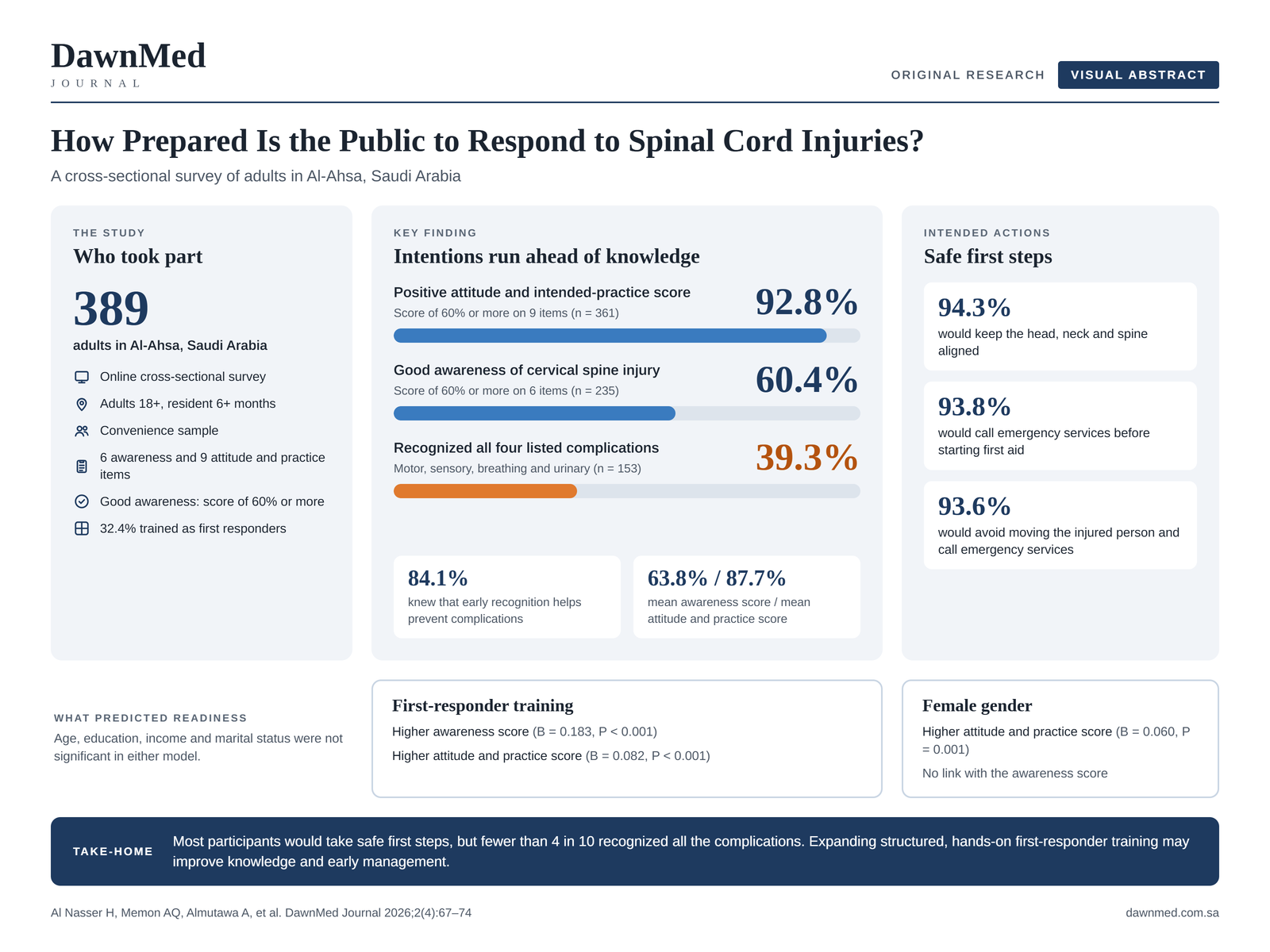
The mean awareness score was 63.8%, and 235 participants (60.4%) had good awareness (score ≥60%). Regarding the individual items, the most correctly answered item was “Early prediction of cervical spine injury helps prevent complications,” reported by 327 (84.1%) participants, followed by “Injuries to the cervical spine can lead to lifelong disability,” reported by 268 (68.9%), “It is possible for a cervical spine injury to be accompanied by spinal cord damage,” reported by 265 (68.1%), “A patient with a cervical spine injury may require medical and physical management throughout their life,” reported by 252 (64.8%), “Signs of cervical spinal cord injury,” reported by 223 (57.3%), and lastly, “Complications of cervical spine injury,” reported by 153 (39.3%) (Table 2).
Table 2. Participants’ responses to awareness items on cervical spine injury (N = 389)
| Items | Categories | N | % |
|---|
| Is it possible for a cervical spine injury to be accompanied by spinal cord damage | Yes | 265 | 68.1 |
| No | 7 | 1.8 |
| Do not know | 117 | 30.1 |
| Can injuries to the cervical spine lead to life-long disability | Yes | 268 | 68.9 |
| No | 19 | 4.9 |
| Do not know | 102 | 26.2 |
| Which of the following are possible complications of cervical spine injury | Motor disability | 148 | 38.0 |
| Sensory disability | 12 | 3.1 |
| Breathing problems | 12 | 3.1 |
| Urinary incontinence | 1 | 0.3 |
| All of the above | 153 | 39.3 |
| Do not know | 63 | 16.2 |
| May a patient with cervical spine injury require medical and physical management for their whole life | Yes | 252 | 64.8 |
| No | 36 | 9.3 |
| Do not know | 101 | 26.0 |
| Early prediction of cervical spine injury helps prevent complications | Yes | 327 | 84.1 |
| No | 8 | 2.1 |
| Do not know | 54 | 13.9 |
| Which of the following signs may indicate cervical spinal cord injury | Pain in arms | 10 | 2.6 |
| Neck deformity | 17 | 4.4 |
| Numbness | 33 | 8.5 |
| Unable to move hands | 32 | 8.2 |
| All of the above | 223 | 57.3 |
| Do not know | 74 | 19.0 |
Mean awareness score 63.8%. Good awareness (score ≥60%): 235 (60.4%).
The mean attitude and intended practice score was 87.7%, and 361 participants (92.8%) had a positive score (≥60%). Regarding the individual items, the highest score was for “I will take extreme care to maintain alignment of the head, neck, and spine,” reported by 367 (94.3%) participants, followed by “I will call emergency services before beginning first-aid intervention,” reported by 365 (93.8%), “I will try not to move the patient and call emergency services,” reported by 364 (93.6%), “If the patient is responsive and I suspect cervical spine injury, I will reassure the patient and tell them to remain still,” reported by 347 (89.2%), “If the patient requires resuscitation, I will call emergency services and start resuscitation while ensuring spinal immobilization,” reported by 343 (88.2%), “A proper response can help the victim,” reported by 335 (86.1%), “I would take spinal movement precautions in an unconscious trauma patient,” reported by 332 (85.3%), “Cervical spine injury can affect the patient’s quality of life until death,” reported by 318 (81.7%), and “I will help people involved in a car accident or fall,” reported by 298 (76.6%) (Table 3).
Table 3. Participants’ responses to attitude and intended practice items on cervical spine injury (N = 389)
| Items | Categories | N | % |
|---|
| How would you respond if the patient requires resuscitation | Call emergency services and start resuscitation while ensuring spinal immobilization | 343 | 88.2 |
| Transport the patient to the nearest hospital in my vehicle | 14 | 3.6 |
| Do nothing | 10 | 2.6 |
| Do not know | 22 | 5.7 |
| I will help people involved in a car accident or fall | Yes | 298 | 76.6 |
| No | 91 | 23.4 |
| A proper response can help the victim | Yes | 335 | 86.1 |
| No | 18 | 4.6 |
| Do not know | 36 | 9.3 |
| Cervical spine injury can affect the patient’s quality of life until death | Yes | 318 | 81.7 |
| No | 18 | 4.6 |
| Do not know | 53 | 13.6 |
| I would take spinal movement precautions in an unconscious trauma patient. | Yes | 332 | 85.3 |
| No | 57 | 14.7 |
| I will try not to move the patient and call emergency services | Yes | 364 | 93.6 |
| No | 6 | 1.5 |
| Do not know | 19 | 4.9 |
| I will call emergency services before beginning first-aid intervention | Yes | 365 | 93.8 |
| No | 24 | 6.2 |
| I will take extreme care to maintain alignment of the head, neck, and spine | Yes | 367 | 94.3 |
| No | 22 | 5.7 |
| If the patient is responsive and I suspect cervical spine injury, I will | Reassure the patient and tell them to remain still | 347 | 89.2 |
| Check neck mobility | 8 | 2.1 |
| Try to change the patient’s position | 6 | 1.5 |
| Do not know | 28 | 7.2 |
Mean attitude and intended practice score 87.7%. Positive score (≥60%): 361 (92.8%).
Multiple linear regression analysis was conducted to identify the factors associated with awareness and attitude scores. The assumptions were evaluated for both the awareness and attitude models. The residuals were approximately normally distributed in both models according to the histograms. No autocorrelation was observed, with Durbin–Watson statistics of 1.940 for the awareness model and 2.138 for the attitude model. No multicollinearity was observed, as the variance inflation factor (VIF) values ranged from 1.060 to 4.039. Furthermore, scatterplots of standardized residuals versus standardized predicted values showed no evidence of heteroscedasticity.
Multiple regression analysis indicated that the awareness model was statistically significant (F = 4.135, P < 0.001), explaining 8.2% of the variance (adjusted R² = 0.082). First responder training was significantly associated with the awareness score (B = 0.183, t = 5.66, P < 0.001). Participants who had received first responder training demonstrated significantly higher awareness scores than those who had not received such training (Table 4).
Table 4. Factors associated with the awareness score (multiple linear regression)
| Predictors | B | t | P-value |
|---|
| Female (Reference: male) | 0.047 | 1.527 | 0.127 |
| First-responder training (Reference: no) | 0.183 | 5.66 | < 0.001 |
| Age (Reference: 26–45 years) | | | |
| 18–25 years | 0.028 | 0.494 | 0.622 |
| More than 45 years | 0.039 | 0.954 | 0.341 |
| Education (Reference: university graduate or above) | | | |
| Secondary school or below | -0.03 | -0.596 | 0.552 |
| University student | 0.046 | 1.173 | 0.242 |
| Monthly income (Reference: < 5,000 SR) | | | |
| 5,000–10,000 SR | 0.009 | 0.201 | 0.841 |
| > 10,000 SR | 0.024 | 0.517 | 0.606 |
| Marital status (Reference: Married) | | | |
| Single | -0.018 | -0.322 | 0.747 |
| Divorced | -0.058 | -0.702 | 0.483 |
| Widowed | 0.147 | 1.145 | 0.253 |
B, unstandardized regression coefficient. Adjusted R² = 0.082; F = 4.135; P < 0.001.
Table 5. Factors associated with the attitude and intended practice score (multiple linear regression)
| Predictors | B | t | P-value |
|---|
| Female (Reference: male) | 0.06 | 3.35 | 0.001 |
| First-responder training (Reference: no) | 0.082 | 4.425 | < 0.001 |
| Age (Reference: 26–45 years) | | | |
| 18–25 years | 0.058 | 1.766 | 0.078 |
| More than 45 years | 0.007 | 0.304 | 0.762 |
| Education (Reference: university graduate or above) | | | |
| Secondary school or below | -0.051 | -1.776 | 0.077 |
| University student | -0.014 | -0.61 | 0.543 |
| Monthly income (Reference: < 5,000 SR) | | | |
| 5,000–10,000 SR | -0.013 | -0.52 | 0.604 |
| > 10,000 SR | 0.043 | 1.6 | 0.11 |
| Marital status (Reference: Married) | | | |
| Single | -0.013 | -0.414 | 0.679 |
| Divorced | 0.085 | 1.787 | 0.075 |
| Widowed | -0.045 | -0.603 | 0.547 |
B, unstandardized regression coefficient. Adjusted R² = 0.102; F = 5.010; P < 0.001.
Multiple regression analysis indicated that the attitude and intended practices model was statistically significant (F = 5.010, P < 0.001), explaining 10.2% of the variance (adjusted R² = 0.102). Gender was a significant predictor of attitude and intended practices regarding cervical spine injury (B = 0.060, t = 3.35, P = 0.001). Female participants demonstrated significantly higher attitude scores than male participants. Furthermore, first responder training was significantly associated with the attitude and intended practice score (B = 0.082, t = 4.425, P < 0.001). Participants who had received first responder training demonstrated significantly higher attitude scores than those who had not received such training (Table 5).
Discussion
This study aimed to assess the level of awareness, attitudes, and intended practices regarding cervical spine injury among adults in Al-Ahsa, Saudi Arabia. Overall, 60.4% of participants had good awareness (mean score 63.8%), while attitudes and intended practices were highly positive (mean score 87.7%; 92.8% with a positive score). Participants showed the greatest awareness of the importance of early recognition of cervical spine injury and its potential consequences, whereas knowledge regarding its complications was the lowest.
In terms of intended practices, most participants reported appropriate responses, including maintaining spinal alignment, avoiding unnecessary movement, contacting emergency services, and reassuring the injured person. First responder training was significantly associated with higher awareness scores and more positive attitudes and intended practices. In addition, female participants had significantly higher attitude and intended practice scores than male participants. These findings highlight the main areas of strength and the remaining knowledge gaps regarding cervical spine injury among the study population.
In the present study, 60.4% of participants had good awareness of cervical spine injury, with a mean awareness score of 63.8%. This proportion was higher than that reported by Al-Otaibi et al., whose questionnaire was adapted for the present study and who found that fewer than one-third of adults across Saudi Arabia had good awareness of cervical spine injury and appropriate first-aid responses [10], and higher than the 53.8% reported among adults in Makkah by Alghamdi et al. [13]. The higher awareness observed in the present study may partly be related to differences in the characteristics of the study populations. In our study, 58.4% of participants were university graduates or above and 32.4% had received first responder training. In comparison, only 19.1% of participants in the earlier nationwide study had been trained as first responders, and that study demonstrated substantially greater awareness among trained participants and those with higher educational attainment [10]. Similarly, the Makkah study reported that university students and participants who had received first-aid training had higher awareness levels [13]. However, the proportion with good awareness in the present study was lower than the 70.2% reported among medical students at Umm Al-Qura University [9] and the 84.9% with sufficient knowledge among senior medical students from different Saudi universities [11]. This difference is expected because medical students receive formal education and clinical exposure related to trauma and emergency management. Supporting this explanation, Tawakul et al. found that good awareness was considerably more common among clinical-year medical students than preclinical students, at 77.6% compared with 54.6% [9].
Regarding individual awareness items, the strongest finding in the present study was recognition that early detection of cervical spine injury can prevent complications, which was correctly identified by 84.1% of participants.
This was slightly higher but generally consistent with previous Saudi studies. Tawakul et al. reported that approximately 80% of medical students recognized the importance of early detection in minimizing complications [9], while Al-Otaibi et al. found that 77.7% of adults recognized that early prediction could prevent complications [10]. Similarly, 77% of adults in Makkah recognized the role of early detection in preventing complications [13]. These consistently high percentages may indicate that the general concept of early recognition and prompt intervention is relatively well understood by the Saudi population, possibly because it represents a simple and frequently emphasized principle of emergency care. The high level of awareness regarding the importance of early recognition of cervical spine injury is encouraging, as rapid identification and early stabilization of spinal injuries are essential for optimizing neurological outcomes. Previous evidence has demonstrated that timely diagnosis and management, including shorter transport times to definitive care, are associated with improved neurological recovery following spinal cord injury [14,15]. In contrast, knowledge of the specific complications of cervical spine injury was the weakest area in our study, with only 39.3% correctly identifying them. A similar knowledge gap was observed in the nationwide study, where only 52.1% recognized motor disability, 39.0% recognized sensory disability, and 28.8% recognized respiratory problems as complications, while 45.8% could not identify any complication [10]. The Makkah study reported somewhat better recognition of motor disability at 73.9%, although awareness of sensory disability and respiratory complications remained lower at 50.1% and 37.9%, respectively [13]. Medical students also demonstrated greater knowledge of complications, with complication awareness ranging from 34.8% to 81.8% in the Umm Al-Qura study [9]. This pattern suggests that while broad messages about the seriousness of cervical spine injury and the importance of early recognition may be familiar to the public, detailed knowledge of neurological, respiratory, and other complications requires more specific medical or first-aid education. The higher complication awareness observed among medical students further supports the potential role of formal education and clinical exposure in addressing this knowledge gap [9,11].
The highly positive level of attitudes and intended practices observed in the present study (87.7%) is consistent with the generally favorable responses reported in previous Saudi studies. Although direct comparison of the overall percentage is limited because previous studies used different scoring approaches, comparison of individual practices shows considerable agreement. In the nationwide study by Al-Otaibi et al., 93.1% of participants reported that they would avoid moving the patient and call emergency services, 96.0% would maintain alignment of the head, neck, and spine, 84.9% would contact emergency services before providing first aid, and 83.8% would reassure a responsive patient and advise them not to move [10]. These findings are very close to the corresponding proportions in our study of 93.6%, 94.3%, 93.8%, and 89.2%, respectively. Similarly, Tawakul et al. reported that 90.4% of medical students would contact emergency services before initiating first aid, 90.1% would maintain spinal alignment, 83.1% would avoid moving the patient and call emergency services, and 79.1% would take spinal movement precautions in an unconscious trauma patient [9]. Most of these percentages were slightly lower than those observed in our study despite the study being conducted among medical students. This may reflect increasing public exposure to first-aid and emergency-response information over recent years, although differences in study populations, questionnaire wording, and data collection methods should also be considered.
The findings were also broadly consistent with other Saudi studies evaluating appropriate first-aid practices. Among medical students, AlMarhoon et al. found that 89% would call an ambulance before beginning first aid, 93.6% would maintain head, neck, and spinal alignment, and all participants reported taking spinal movement precautions in unconscious trauma patients and reassuring responsive patients not to move [11]. The higher percentages for some practices in that study, particularly spinal precautions and reassurance, may be explained by the medical background of the participants and their greater formal exposure to emergency and trauma management. In Makkah, 91.7% of adults reported that they would call emergency services and then provide first aid, 96.8% would avoid inappropriate movement while maintaining spinal stability, and 80.0% would take preventive measures in an unconscious patient [13]. Likewise, a study from Taif found that 95.9% understood that a casualty with suspected spinal cord injury should not be moved randomly from the accident scene and 89.3% recognized the importance of securing the head during transport [12]. Collectively, these findings indicate a consistently high willingness to adopt basic protective measures across different Saudi populations. This is particularly important because inappropriate handling and excessive spinal movement may aggravate the initial injury and increase the risk of secondary spinal cord injury [10], while inappropriate stabilization has also been associated with an increased likelihood of complications [13].
First responder training was significantly associated with both higher awareness and more positive attitudes and intended practices in the present study. This finding is strongly supported by previous Saudi evidence regarding awareness. Al-Otaibi et al. reported that 97.1% of participants who had received first responder training had good awareness compared with only 16.4% of those without such training [10]. Similarly, the Makkah study found good awareness among 69.3% of participants trained in cervical spine injury first aid compared with 51.1% of those without training, with a statistically significant association [13]. The Makkah study also showed that better awareness was associated with more appropriate intended practices, including providing assistance, taking precautions in unconscious patients, calling emergency services, and maintaining spinal stability [13]. The importance of these findings is particularly evident in suspected cervical spine injury, as improper handling or unnecessary movement may aggravate an unstable spinal injury and result in secondary neurological deterioration. Previous studies have shown that neurological deterioration following spinal trauma may be preventable through early suspicion of spinal injury, appropriate handling, and adequate spinal motion restriction [16,17]; appropriate first-aid management may therefore help prevent further neurological damage and associated complications [10,12,13]. These findings support the possibility that first responder training not only improves knowledge but may also increase preparedness and confidence in performing appropriate actions during emergencies. However, the available studies did not directly evaluate training as an independent predictor of attitude and intended practice scores in the same manner as our regression model. Therefore, the present finding adds further evidence regarding the potential importance of structured first responder training in translating awareness into appropriate intended behavior.
Female participants in the present study had significantly higher attitude and intended practice scores than male participants. This finding cannot be directly compared with previous studies because most evaluated gender differences in awareness rather than attitudes or intended practices. Furthermore, their findings regarding gender and awareness were inconsistent. Tawakul et al. reported slightly higher good awareness among female medical students than males, at 73.2% and 69.3%, respectively [9]. In the Makkah study, females also showed somewhat higher good awareness than males, at 55.9% versus 49.5%, although the difference was not statistically significant [13]. In contrast, Al-Otaibi et al. reported significantly greater awareness among males than females and suggested that this could be related to greater previous exposure to similar injuries [10]. The variation across studies may therefore reflect differences in study populations, previous experience, first-aid exposure, and the outcomes being measured.
Limitations
This study has several limitations. The use of convenience sampling and electronic questionnaire distribution may have introduced selection bias, particularly because individuals with internet access, higher educational attainment, or greater interest in health-related topics may have been more likely to participate. Consequently, the findings may not represent all adults in Al-Ahsa or be generalizable to other regions of Saudi Arabia. The cross-sectional design also prevents temporal or causal conclusions regarding the relationships between participant characteristics, training, awareness, and intended practices. In addition, responses were self-reported and described intended actions in hypothetical situations; therefore, they may have been affected by recall or social desirability bias and may not reflect actual performance during an emergency. Although the adapted questionnaire demonstrated acceptable internal consistency and underwent expert face-validity assessment, it did not include direct observation or practical evaluation of first-aid skills.
Conclusion
In this study, 60.4% of participants had good awareness of cervical spine injury (mean score 63.8%), and attitudes and intended first-aid practices were highly positive. Participants were generally aware of the importance of early recognition and reported appropriate protective responses, including contacting emergency services, limiting unnecessary movement, and maintaining spinal alignment. Nevertheless, knowledge of the possible complications of cervical spine injury remained limited. First-responder training was independently associated with both greater awareness and more favorable attitudes and intended practices, while female participants had higher attitude and intended practice scores. These findings support wider access to structured, practical first-aid training and targeted public education emphasizing complication recognition and safe early management. Future studies should use probability-based sampling and practical assessments to determine whether intended responses translate into appropriate actions during real emergencies.
Declarations
Ethical Approval: Research Ethics Committee, King Faisal University (KFU-REC-2026-AUG-ETHICS4361), approved 10 August 2026.
Informed Consent: All participants provided informed consent before completing the questionnaire.
Conflicts of Interest: The authors declare that they have no conflicts of interest related to this study.
Funding: This research received no specific grant from any funding agency in the public, commercial, or not-for-profit sectors.
Acknowledgements: The authors sincerely thank all individuals who participated in this study. They also acknowledge the experts who contributed to the face-validity assessment of the questionnaire.
Author Contributions: Hassan Al Nasser contributed to conceptualization, study design, and manuscript drafting. Abdul Qadeer Memon contributed to supervision, methodology, and critical revision. Abdulaziz Almutawa handled data curation, analysis, and interpretation. Mohammed Alhawaj contributed to recruitment, data collection, and drafting. Ali Alghawi supported literature review, questionnaire development, and revision. Abdulaziz Al Muqahwi assisted with data collection and project coordination. Fatimah Alakroush contributed to questionnaire validation, data curation, and drafting. Mohammed Al Hijji supported recruitment, investigation, and revision. Yaqin Alali and Abdulmohsen Alkhars contributed to analysis and results interpretation. Sharefa Alshawi assisted with literature review and editing. Saleh Alomari contributed to administration, data collection, and revision. All authors approved the final manuscript and are accountable for the work.